On-premise low-code security means your organization owns every layer of protection: servers, runtime, application logic and data all sit inside your boundary. That gives you full control over data location and access, which is exactly what UAE banks, healthcare providers and government entities need. It also means you configure and maintain the controls yourself. This guide shows which layers to secure, which risks to expect, which controls to require and which UAE rules to check.
TL;DR
- On-premise low-code moves security responsibility to you. The upside is control over data location, network and access, which UAE regulated sectors often require.
- Secure four layers separately: infrastructure, runtime, application and data.
- The most common problems are misconfiguration, unsecured endpoints, implicit user identities and unvetted custom plugins or integrations.
- UAE organizations should check the PDPL, the Central Bank rulebook for banks and the UAE Information Assurance Standard before choosing a deployment model.
- Governance matters as much as technology: restrict who builds, approve environments, and monitor continuously.
Table of Contents
- What on-premise low-code security actually covers
- The main risks to plan for
- Controls to require for an on-premise platform
- Governance: who gets to build what
- UAE requirements to check before you deploy
- Testing and monitoring after go-live
- Use cases where on-premise low-code fits
- How Singleclic helps
- Our perspective
- Plan your secure on-premise low-code deployment
- Article details
- FAQ
- Sources
What on-premise low-code security actually covers
A low-code platform lets teams build workflows and applications with visual tools instead of hand-written code. When you deploy it on-premise, the platform runs in your own data center or private hosting, not on a vendor’s public cloud.
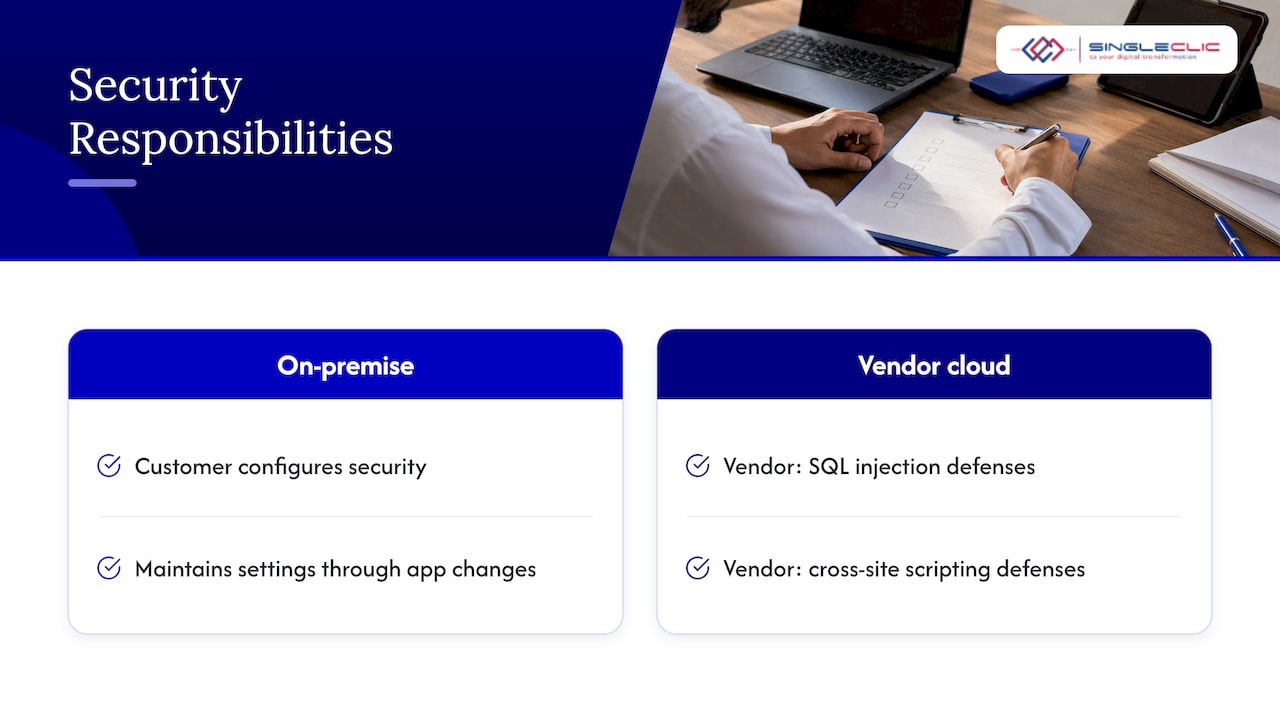
That changes who does what. Forrester’s analysis of low-code security found that customers carry more responsibility for configuring security and keeping those configurations intact through application changes when the platform runs in their own data center, while on a vendor cloud the vendor takes on major protections such as defenses against SQL injection and cross-site scripting.
Read that as a division of labor, not a verdict. An on-premise deployment with a clear owner for each control is a strong setup. The risk appears when nobody owns the configuration.
If you are still weighing deployment models, our comparison of cloud security versus on-premise trade-offs and our piece on hybrid deployment with low-code cover the decision itself.
The four layers to secure
Security researcher Michael Bargury describes four layers in a low-code application: infrastructure (servers, network, operating system, virtualization, containers), the runtime environment, the application itself (business logic, widgets, connectors, third-party components) and the data. A useful way to apply this on-premise is to assign an owner to each layer.
| Layer | What it includes | Typical owner on-premise |
|---|---|---|
| 1. Infrastructure | Servers, network, OS, containers | Infrastructure and network team |
| 2. Runtime | The low-code engine and its configuration | Platform administrator |
| 3. Application | Logic, forms, connectors, plugins | Application owners and developers |
| 4. Data | Databases, files, backups | Data owner and security team |
When all four owners are named, gaps become visible. When a layer has no owner, that is where incidents tend to start.
The main risks to plan for
Most low-code incidents are not exotic attacks. They are configuration and design mistakes, and they apply on-premise as much as anywhere.
Misconfiguration and exposed endpoints
Bargury’s OWASP-based list of low-code risks points to misconfigurations that allow anonymous access to sensitive data or operations, unprotected public endpoints, unprotected secrets and oversharing. Forrester adds that forgetting to secure endpoints is a common mistake. A 2023 academic study in the journal Cyber reached a similar conclusion: wrong configuration and flawed business logic are the main concerns when building applications on low-code platforms.
The practical lesson: every new form, API or workflow trigger needs an authentication check before it goes live.
Implicit identities and privilege escalation
Low-code applications can embed a user identity that any application user then uses implicitly. That creates a direct path to privilege escalation and lets an attacker act behind another person’s identity, bypassing traditional controls. In practice, check which service account or user context each connector runs under, and give it the minimum rights it needs.
Custom code, plugins and integrations
Risk rises when developers step outside the platform’s native tooling. Forrester notes that custom code, custom interfaces and integrations with external databases, applications or cloud services increase application-security exposure. The Cyber study found that injection problems can appear when custom components are developed, while pre-defined components mainly raise configuration and business-logic issues. It also found that externally developed plugins can cause data leakage when they connect to unknown or unauthorized parties.
So prefer the platform’s pre-built components where they fit, and put custom plugins through the same review as any other code.
The bridge back to the cloud
Many on-premise projects still connect to cloud services, such as a messaging gateway or an analytics tool. Bargury warns that bridging cloud and on-premise assets effectively opens private resources to the public Internet, so access should be restricted, encrypted and monitored at all times. Treat every outbound and inbound connection as a controlled gateway, not a convenience.
Controls to require for an on-premise platform
Use this list as a baseline when you evaluate a platform or review an existing deployment.
- Secrets management. Keep keys and passwords in a dedicated vault, not inside application definitions. Microsoft’s secure development guidance for Power Platform recommends storing secrets in external resources, using connectors with secure authentication, avoiding HTTP for custom connectors and avoiding hard-coded URLs or keys. The same page recommends approved and unapproved lists of frameworks, libraries and vendors, plus automated dependency vulnerability scans.
- Role-based access with least privilege. Separate platform administrators, developers, testers and business users. Review roles on a fixed schedule.
- Encrypted traffic everywhere. Internal service-to-service calls included, not only the user-facing interface.
- Network segmentation. Place the runtime, the data stores and the integration gateway in separate zones with explicit rules between them.
- Audit logging. Log who built, changed, approved and ran each process, and send logs to your security monitoring.
- Patch management. Include the platform, its dependencies and the operating system in your regular patch cycle.
- Backup and recovery. Test restores, and keep backups under the same data-location rules as production.
- Change control. Treat workflow changes as releases: reviewed, tested in a separate environment, then promoted.
Our own notes on security and governance in low-code platforms expand on how these controls fit into a governance model.
Governance: who gets to build what
Low-code puts building tools in the hands of business teams. That speed is the point, and governance keeps it safe. RSM US’s governance guide recommends that citizen developers have no persistent, elevated or administrative access, that creating applications or environments requires approval, and that access settings are managed by a predefined administrator. It also recommends application-development standards training for them.
The same guide suggests guardrails at the environment level: production environments managed, data loss prevention policies enabled in every environment, and security, audit and monitoring switched on. Although the guide is written for Microsoft’s platform, the principles carry over to any low-code environment you run on-premise.
A workable operating model looks like this:
- A central platform team owns configuration, patching and the approved component list.
- Business developers build inside approved environments, using approved connectors.
- A review gate applies before anything touches sensitive data or an external system.
- A retirement process removes unused applications, so forgotten apps do not stay exposed.
For a deeper blueprint, see our governance blueprint for Power Platform, Dynamics 365 and Odoo.
UAE requirements to check before you deploy
In the UAE, deployment location is often a compliance question as much as a technical one. Check these items with your legal and security teams.
Personal data: the PDPL
The UAE Personal Data Protection Law, Federal Decree-Law No. 45 of 2021, took effect on 2 January 2022 and governs the processing of personal data of UAE residents. Article 20 requires appropriate technical and organizational measures, and Articles 22 and 23 restrict cross-border transfers. An on-premise deployment inside the UAE keeps personal data in a location you control, which simplifies the transfer question for applications that handle employee, patient or customer records.
Banks and financial institutions
The Central Bank of the UAE rulebook is explicit. Its data movement section states that the customer and transaction database must be held within the UAE and kept proprietary. Outside access is barred, with restricted access allowed for an IT service provider maintaining outsourced IT, and policies must cover backups and off-site backup storage. Separately, the rulebook requires banks to establish IT policies and processes to identify, assess, monitor and manage technology risks, with infrastructure that ensures data and system integrity, security and availability.
For a bank, a low-code platform that runs on-premise and supports Arabic interfaces fits this model directly, because the process data never leaves your environment.
Critical services: the UAE Information Assurance Standard
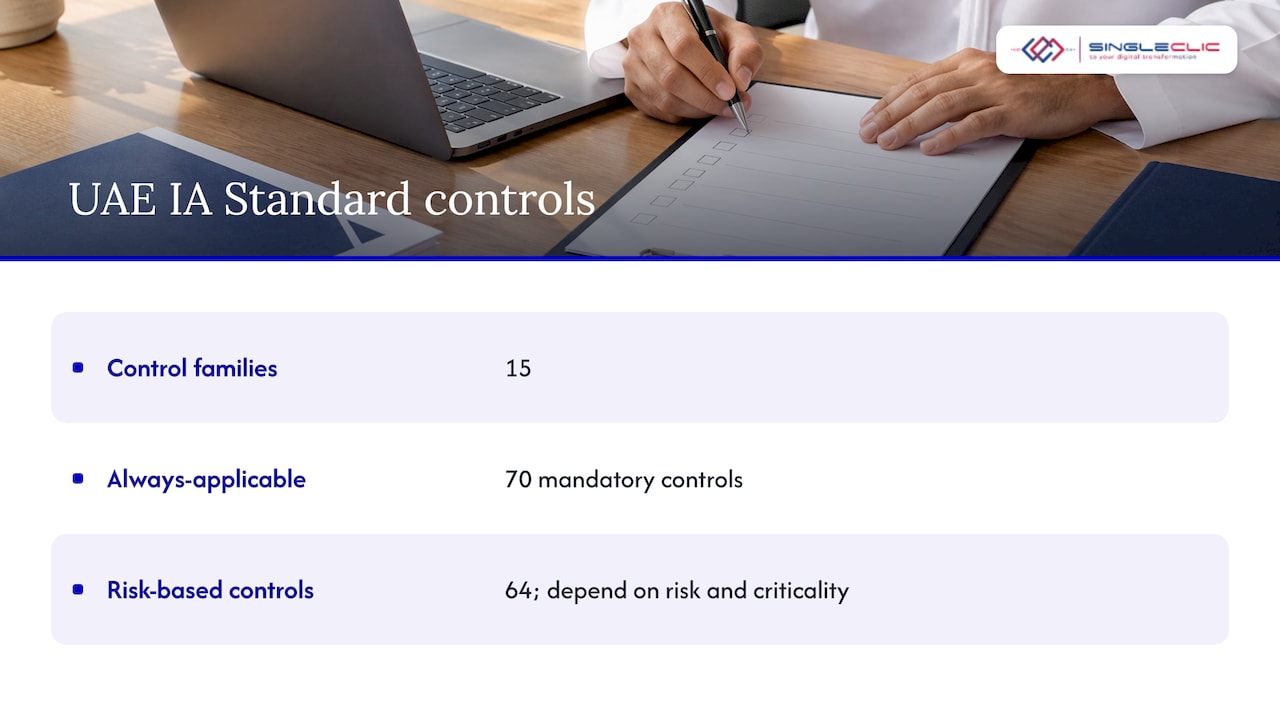
KPMG’s analysis explains that UAE Information Assurance Standard v2.1, released in November 2025, replaced the earlier v1.1 regulation. It sets a national minimum baseline for public and private entities that deliver or support critical services, organized into 15 control families with 70 always-applicable controls and 64 risk-based controls. Always-applicable controls are mandatory for in-scope entities, while risk-based ones depend on your risk profile and criticality. That lets you prioritize by risk rather than apply one uniform model.
If your organization is in scope, map each platform control from the previous section to the standard’s control families. That mapping becomes your evidence.
Testing and monitoring after go-live
A secure launch is the start, not the finish. Build these habits into operations:
- Test before release. Run security testing against every new or changed application in a separate environment, and include penetration testing for anything exposed to external users.
- Scan dependencies automatically. Microsoft’s guidance cited above recommends automating dependency vulnerability scans.
- Review identities and connectors regularly. Look for service accounts with excessive rights and endpoints that no longer need to be public.
- Monitor continuously. Feed platform audit logs into your security operations tooling, so unusual activity triggers an alert instead of waiting for a yearly audit.
- Keep evidence ready. Store approvals, test results and access reviews in a form an auditor can read.
As a rule of thumb, an annual review is a floor. Anything touching regulated data deserves a review each time the process changes.
Use cases where on-premise low-code fits
- Banking approvals and onboarding. Credit, KYC and account workflows run on data that must stay inside the UAE. An on-premise platform keeps the whole process in your own environment.
- Healthcare workflows. Patient-related approvals, referrals and supply requests involve sensitive personal data, which makes local control valuable.
- Government services. Permit, procurement and case-management processes benefit from controlled deployment and full audit trails.
- Construction and real estate. Contract approvals, procurement and site reporting connect to ERP and CRM data that you may prefer to keep in-house.
- Telecom operations. Provisioning and incident workflows link many legacy systems, and a controlled integration layer reduces exposure.
Our article on how low-code simplifies multi-system integrations shows how to connect these systems without scattering credentials.
How Singleclic helps
Singleclic is a regional Microsoft Dynamics 365, Odoo and IBM partner with more than ten years of delivery in the region, 70+ consultants and engineers across KSA, UAE and Egypt, and 100+ enterprise clients, including Emirates Health Services, Dubai Healthcare City and QNB.
For on-premise low-code, we offer Cortex, our Arabic-enabled, on-premise low-code and BPM platform built for MENA enterprises. Cortex is designed to connect approvals, ERP, CRM, data, legacy systems and workflows, with a full Arabic interface, unlimited users, on-premise deployment for banks and governments, and runtime workflow changes without downtime. Around it we provide ERP and CRM implementation, business process automation, system integration and an on-premise LLM option for organizations that want AI without sending data outside their environment.
Our low-code development services cover design, build and integration, and our Cortex low-code platform page describes the platform in detail. For the broader picture, read our guide to risks and limitations in low-code systems and our explainer on low-code development for IT and business leaders.
Our perspective
Security on-premise is not a feature you switch on. It is a set of decisions you make once, document, and keep making: who builds, what connects, where data sits and who can see it.
We see the strongest results when organizations decide these questions before the first workflow is built. A bank or government entity in the UAE rarely wants less control. It wants control that does not slow the business down. That is why we designed Cortex to run on-premise, with an Arabic interface, and to let teams change a live workflow without downtime, so governance and agility are not a trade-off.
Our advice to CIOs and CTOs is simple: assign an owner to every layer, keep integrations through a controlled gateway, and treat every process change as a release. Do that, and an on-premise platform becomes a security advantage, not a maintenance burden.
Tamer Badr
Plan your secure on-premise low-code deployment
If you are planning an on-premise low-code or process automation project in the UAE or Saudi Arabia, our team can help you scope the architecture, controls and governance model together. Explore Cortex and our other platforms or review our full list of services.
Talk to Singleclic about a security-first design for your next automation project.
Article details
- SEO title: Low-code security on-premise: a guide for UAE enterprises
- Slug: low-code-security-on-premise
- Primary keyword: low-code security on-premise
- Secondary keywords: on-premise low-code platform, low-code governance, Cortex low-code, workflow automation security, UAE data residency
- Pillar cluster: Low-code development, security and governance
FAQ
Is on-premise low-code more secure than cloud low-code?
It depends on who runs the controls. On-premise gives you control over data location and network boundaries, but you also take on configuration and maintenance, which Forrester describes as a greater customer responsibility. With clear ownership of each layer, it is a strong choice for regulated UAE sectors.
Does the UAE require data to stay inside the country?
It depends on the sector. For banks, the Central Bank rulebook requires the customer and transaction database to be held within the UAE. For personal data generally, the PDPL restricts cross-border transfers. Confirm your own obligations with your legal and compliance teams.
What is the biggest security risk in low-code applications?
Misconfiguration is the most repeated finding. Research points to anonymous access, unprotected endpoints, unprotected secrets and oversharing as typical examples, as set out in the OWASP-based low-code risk list. A review gate before go-live catches most of them.
Should business users be allowed to build applications?
Yes, inside guardrails. Give them approved environments and connectors, no administrative access, and training on development standards, as RSM US recommends. Route anything touching sensitive data through a review.
Can Cortex run fully on-premise?
Yes. Cortex is Singleclic’s on-premise low-code platform, built for MENA enterprises and supporting a full Arabic interface and on-premise deployment for banks and governments. Contact our team to discuss architecture and integration with your ERP, CRM and legacy systems.
Sources
- Low-Code Development Requires A Security Rethink, Forrester
- Addressing the Low-Code Security Elephant in the Room, Dark Reading
- OWASP Top 10 Risks for Low-Code/No Code, Michael Bargury
- You Are Doing it Wrong: On Vulnerabilities in Low Code, Cyber 2023
- Secure a development lifecycle, Microsoft Learn
- App development governance guide, RSM US
- UAE PDPL overview, CISGuard
- 14.5 Data Movement, Database and Back-up, CBUAE Rulebook
- Article 8: Information Technology, CBUAE Rulebook
- A bold step towards cyber resilience, KPMG