AI RFP response automation uses AI to read a tender or RFP, find the right approved answers in your own content, draft responses against each question and route risky items to a named expert before anything is submitted. Done well, it removes the copy-and-paste work and leaves your specialists to review claims, price and strategy. Done badly, it produces confident answers nobody can trace. This guide shows the workflow, the systems behind it, the controls UAE organizations need and how to measure the result.
TL;DR
- AI RFP automation works as a pipeline: ingest the document, classify and route questions, retrieve approved content, draft with citations, pass a human gate, then export in the buyer’s format.
- Reliable answers depend on a curated, permissioned library, not on the model alone. Keep the sources approved and current.
- Claims about certifications, data residency, insurance limits and pricing always need a named human approver.
- In the UAE, personal data and confidential bid material fall under federal and free zone data protection rules, so design access and retention first.
- Measure time to first draft, cycle time, specialist hours per bid, answer reuse and citation coverage, not just “hours saved”.
Table of Contents
- What AI RFP response automation actually does
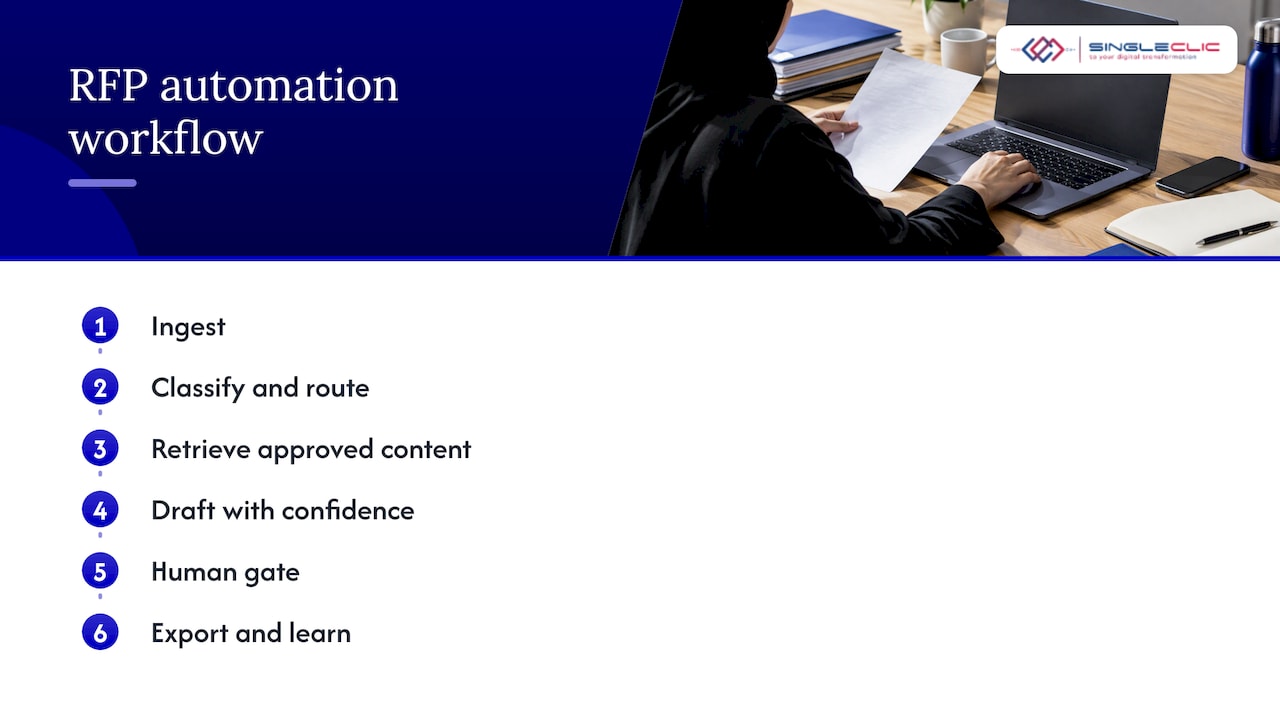
- The six-stage workflow from intake to submission
- What data and systems the workflow needs
- Operating rules that prevent most incidents
- Data protection and confidentiality in the UAE
- Common mistakes and how to avoid them
- How to measure whether it works
- Our perspective
- Use cases beyond the sales team
- How Singleclic helps
- Ready to automate your bid process?
- Article details
- FAQ
- Sources
What AI RFP response automation actually does
An RFP response is rarely a writing problem. It is a coordination problem. A 120-question security questionnaire, a pricing schedule, a set of case studies and a compliance matrix land in one inbox, and five departments each own a piece. Most of the time goes into finding the last approved answer, chasing the person who owns it and reformatting everything for the buyer’s template.
AI automation targets exactly those mechanical steps. It parses the buyer’s documents into a structured question list, matches each question to approved content, drafts an answer, flags what it cannot support and tracks every item to completion. The model writes sentences, but the value comes from the workflow around it: which sources it may read, who must approve what and how the final package is assembled.
This is why general chat assistants alone disappoint on bids. They write fluent text with no knowledge of your certifications, your delivery model or what you promised the last client. A grounded workflow answers from your evidence and shows where each statement came from.
The six-stage workflow from intake to submission
A practical RFP automation design performs six jobs in sequence. Each one can be built on a workflow platform, connected to your document stores and ERP or CRM data.
1. Ingest
The system accepts Word, PDF and Excel files and portal questions, then converts them into one structured list: question, section, mandatory or optional, word limit and deadline. Scanned tables and mixed Arabic and English documents need particular care here, because a missed mandatory requirement is a disqualification risk, not a formatting issue.
2. Classify and route
Every question gets a category and an owner. Security and compliance questions go to the information security lead, technical questions to delivery, pricing to the commercial team and legal terms to counsel. Routing at the start means specialists work in parallel instead of waiting for a single bid manager to forward emails.
3. Retrieve
For each question, the system searches your approved knowledge base using retrieval-augmented generation (RAG). It pulls the most relevant passages from past proposals, product documentation and policies, and passes only those to the model. Restricting the model to retrieved, approved text is the single most effective control against invented answers.
4. Draft with confidence
The model drafts a first answer, attaches the source passages and assigns a confidence level. Reviewers see the draft and its evidence side by side, so checking takes seconds instead of a research task. A reviewer who cannot see the source has no way to trust the sentence.
5. Human gate
Low-confidence items, gaps in the knowledge base, new claims and anything legal or security-sensitive stop here until a named subject matter expert approves them. Agent-based designs commonly route to people when confidence is low, information is missing from the approved base or sources contradict each other. We treat that gate as the core of the system, not an extra step.
6. Export and learn
The approved answers are exported in the buyer’s own format. Win and loss outcomes can be tagged, and corrected answers flow back into the library, so the next bid starts from better content than the last.
What data and systems the workflow needs
The quality of an automated response is capped by the quality of what it can read. Build the library deliberately.
| Content type | Why it matters | Control to apply |
|---|---|---|
| Past proposals and approved answers | Source of tone, structure and proven wording | Remove customer secrets and pricing before indexing |
| Product and service documentation | Keeps technical statements accurate | Version it; retire superseded files |
| Security and privacy documents | Answers the questionnaire section | Approved-only, never improvised |
| Legal boilerplate and terms | Avoids unreviewed commitments | Counsel owns changes |
| Case studies and metrics | Gives evidence the buyer can weigh | Only client-approved references |
| Delivery, support and SLA material | Supports commitments on timelines and service | Owned by delivery leadership |
On the systems side, the workflow should connect to wherever your content already lives, such as SharePoint, OneDrive or Confluence, and to your CRM so the opportunity record and the bid stay in step. Role-based access, single sign-on and audit trails matter because a bid library holds some of the most commercially sensitive material you own. Personnel files, passport copies and salary data have no place in it.
If your ERP and CRM already hold clean product, pricing and customer data, the AI layer can read from them rather than from stale documents. Our guide to an AI ERP system for UAE and Saudi decision-makers explains how that foundation supports AI use cases.
Operating rules that prevent most incidents
Most failures in AI-assisted bids are process failures. A short rule set prevents the majority of them:
- Approved sources only for sensitive claims. Certifications, data residency, insurance limits and pricing come from a controlled source and a named approver.
- No auto-submission. Every portal answer has a named owner who presses the button.
- Redact before you index. Strip customer names, confidential terms and prices from past bids before they enter the library.
- Keep personal data out. CVs, ID documents and salary files stay in HR systems. Where team biographies are needed, use approved, consented versions.
- Log everything. Keep who drafted, who approved and which source supported each answer.
- Review the library, not only the answers. An outdated source repeated confidently is still wrong. Assign owners and review dates to content.
These rules track what practitioners publish about AI proposal workflows for UK and UAE teams, and they work because they are boring and enforceable.
Data protection and confidentiality in the UAE
An RFP package usually contains three kinds of sensitive material: your own commercial information, the buyer’s confidential information and personal data about people on both sides. Each needs a handling rule before you connect an AI tool.
Personal data. The UAE’s federal personal data law, Federal Decree-Law No. 45 of 2021, came into force on 2 January 2022. It gives individuals rights to access, correct, delete and port their data and requires breach reporting. Organizations in the Dubai International Financial Centre also fall under DIFC Law No. 5 of 2020, which requires personal data to be processed lawfully, for specified and legitimate purposes, limited to what is necessary and kept secure with appropriate technical or organizational measures. In practice, that points to data minimization: do not feed names, IDs or personal contact details into a bid library unless the answer needs them.
Buyer confidentiality. Government and regulated buyers often attach confidentiality terms to tender documents. Check those terms before uploading anything to an external AI service. For banks, health bodies and government entities, an on-premise or in-country deployment of the model and the library is often the simplest way to keep material where it belongs. Our articles on the UAE data residency roadmap and data security practices for IT teams in the UAE and KSA cover the infrastructure side, and the digital compliance guide for KSA, UAE and Egypt maps the wider obligations.
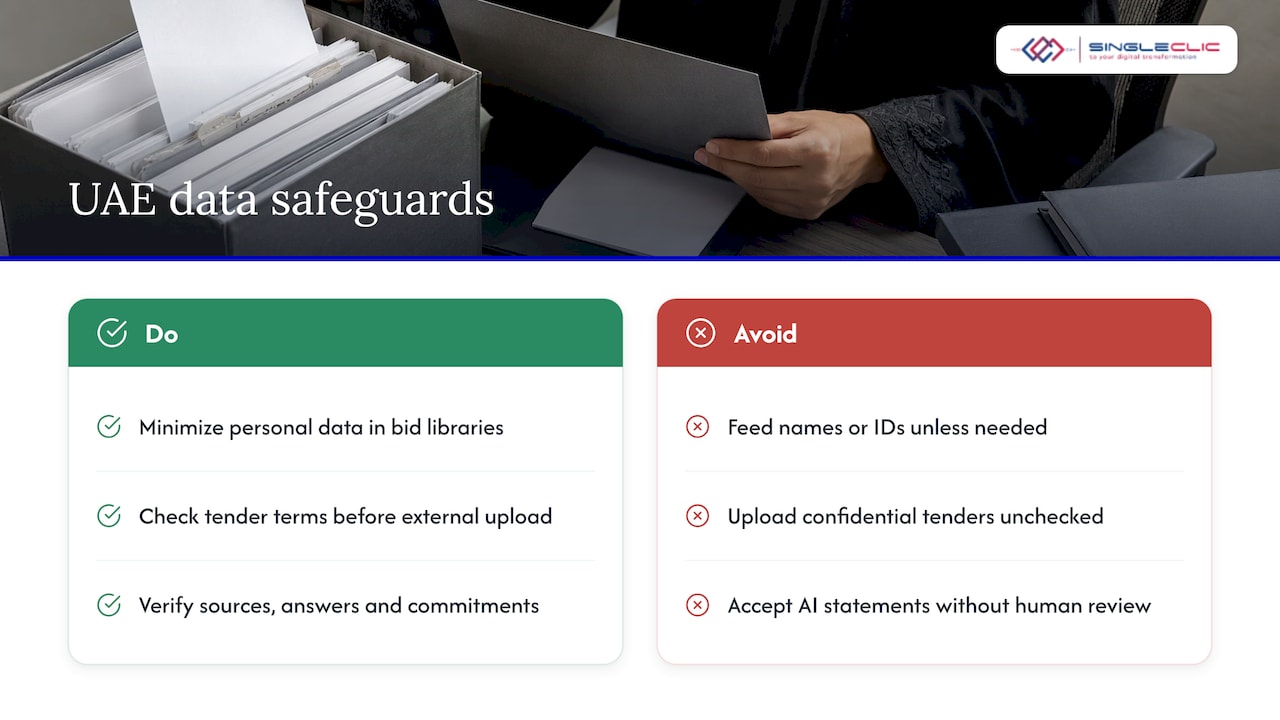
Verification. Treat every AI statement as a draft until a person has checked it against its cited source. Ask reviewers to confirm three things: the source exists and is current, the answer matches the question as asked and no new commitment has slipped in.
Common mistakes and how to avoid them
- Indexing everything. A library full of old, contradictory proposals produces contradictory answers. Curate first, then index.
- Treating confidence as correctness. A fluent answer with no source is the main risk. Require citations and display them to reviewers.
- Skipping the redesign. Automating a messy bid process only makes the mess faster. Map who approves what before you build; our piece on redesigning before you automate explains the method.
- No owner for the knowledge base. Content decays within months. Name an owner per topic.
- Letting AI make commercial decisions. Pricing, discounts, bid or no-bid and contractual deviations stay with leadership.
- Ignoring language. Many Gulf tenders mix Arabic and English. Test the workflow on real bilingual documents before relying on it.
How to measure whether it works
Pick a baseline before launch, then track the same measures on every bid. Useful operational metrics include time to first draft, total cycle time, specialist hours per RFP by function, reuse rate of approved answers and the share of responses with citations. Add RFP participation rate (how many opportunities you can now afford to answer) and shortlist rate, while being careful about attribution: a better shortlist rate may come from better targeting, not only from faster drafting.
A simple starting scorecard:
| Metric | Question it answers |
|---|---|
| Time to first draft | Is intake and retrieval working? |
| Cycle time, intake to submission | Is the whole process faster? |
| Specialist hours per bid | Are experts spending time on judgment, not lookup? |
| Reuse rate of approved answers | Is the library earning its keep? |
| Share of answers with citations | Can reviewers verify quickly? |
| Participation and shortlist rate | Are you bidding more, and bidding better? |
Our perspective
RFP automation is a business process problem before it is an AI problem. The model is the easy part. The hard part is deciding who owns each answer, which documents count as approved and what happens when the system is unsure.
That is why we build these workflows on a process platform rather than a standalone chat tool. In our work across Saudi Arabia and the UAE, the organizations that get value are the ones that connect approvals, ERP, CRM, data and legacy systems into one controlled flow. Our Cortex low-code platform is designed for this: Arabic-enabled, deployable on premise for banks and government bodies, and able to change workflows at runtime without downtime.
Start small. Take one bid type, one library and one approval chain, measure it for a quarter and extend from there. Confidence in the output should come from visible evidence and clear ownership, not from the model.
Tamer Badr
Use cases beyond the sales team
The same pipeline serves several teams:
- Procurement and supply chain: responding to vendor questionnaires and prequalification forms from large buyers.
- Construction and real estate: assembling tender packages with project histories, method statements and compliance documents.
- Healthcare: answering accreditation and data handling questionnaires from health authorities and insurers.
- Banking and government: completing security and resilience assessments where on-premise deployment is a requirement.
- HR: answering staffing and compliance sections of service tenders. See our view on AI in HR for the data handling side.
How Singleclic helps
We design and implement the workflow layer around the AI: intake, routing, approvals, integrations and reporting. Our AI solutions, process automation and low-code services cover the build, and our business process automation approach shows how AI fits into governed workflows. Where your approvals already run through Microsoft Dynamics 365 or IBM Business Automation Workflow, we integrate with them rather than adding another silo; see our Dynamics 365 services and IBM BAW guide for UAE leaders.
Ready to automate your bid process?
If your team answers a steady flow of RFPs, tenders and security questionnaires, we can map your current process, define the approval gates and build a controlled workflow on Cortex, our Arabic-enabled low-code and BPM platform, with on-premise deployment where your sector requires it.
Explore the Cortex low-code platform or talk to our team about a pilot for your next bid cycle.
Article details
- SEO title: AI RFP response automation: a workflow for UAE enterprises
- Slug: ai-rfp-response-automation
- Keyword: ai rfp response automation
- Secondary keywords: RFP workflow automation, AI proposal response, tender response automation, RFP automation UAE
- Pillar cluster: Business process automation and enterprise AI
FAQ
What is AI RFP response automation?
It is the use of AI, usually retrieval over your approved content plus a language model, to parse an RFP, draft answers with citations and route sensitive items to people. The goal is to cut manual lookup and reformatting while keeping experts in control of claims and pricing.
Can AI submit an RFP response on its own?
We advise against it. Every answer sent to a buyer should have a named human owner who has checked the sources, especially for certifications, data residency, insurance and pricing. AI prepares and organizes; people approve and submit.
What content should we load into the system first?
Start with approved past answers, product documentation, security and privacy policies, legal boilerplate, approved case studies and service level material. Remove customer secrets and personal data before indexing, and assign an owner to each content area.
Is it safe to use AI on tenders in the UAE?
It can be, if you control where data goes. Check the buyer’s confidentiality terms, apply the federal personal data law and, in the DIFC, DIFC Law No. 5 of 2020. Regulated organizations often choose in-country or on-premise deployment.
How do we know it is working?
Track time to first draft, cycle time, specialist hours per bid, reuse of approved answers and the share of answers with citations against a pre-launch baseline. Review shortlist rates over several bid cycles rather than one.
Sources
- DIFC Law No. 5 of 2020, UAE Government portal
- AI, data and governance: the emerging regulation landscape in the UAE
- AI RFP and proposal response workflows for UK and UAE agencies
- How to automate RFP responses with AI agents