SEO Title: The Best Tools for Digital Transformation in 2026
Meta Description: Discover the essential tools for digital transformation — from AI and ERP to RPA and cloud platforms — with practical guidance for business leaders selecting the right stack.
Slug: tools-for-digital-transformation
Primary Keyword: tools for digital transformation
Secondary Keywords: digital transformation software, enterprise digital tools, digital change management tools, cloud solutions for transformation, digital innovation platforms
Pillar Cluster: Digital Transformation / Enterprise Technology
Which tools actually drive digital transformation?
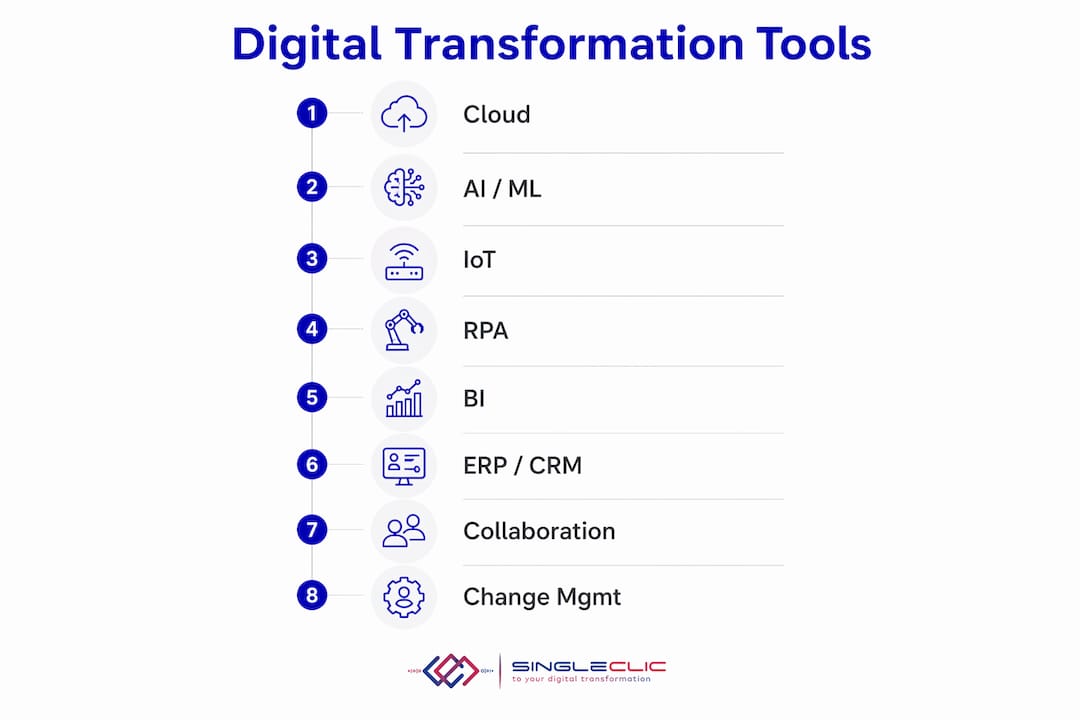
The right tools for digital transformation span at least eight distinct categories: AI and machine learning, cloud computing, IoT, cybersecurity, business intelligence, enterprise platforms (ERP, CRM, HR), communication and collaboration software, and project management. Getting the category mix right matters more than picking any single product. Many digital transformation initiatives face significant challenges in execution and tool adoption, leading to high failure rates, and most of those failures trace back to mismatched tooling, not a lack of ambition.
Here is a quick map of the core categories and what each one contributes:
- AI and ML tools: Automate repetitive decisions, surface predictive insights, and personalize customer interactions at scale.
- Cloud computing platforms: Provide the infrastructure backbone for agility, global access, and reduced capital expenditure.
- IoT devices and platforms: Feed real-time operational data from physical assets into digital systems.
- Cybersecurity tools: Protect expanded digital surfaces through endpoint defense, identity management, and threat detection.
- Business intelligence (BI) software: Turn raw data into dashboards, forecasts, and decisions executives can act on.
- Enterprise platforms (ERP, CRM, accounting, HR): Integrate core business functions so data flows across departments without manual handoffs.
- Communication and collaboration tools: Keep distributed teams aligned and reduce information silos.
- Project and workflow management software: Track deliverables, allocate resources, and maintain accountability across transformation programs.
No single tool covers all eight. The organizations that succeed treat these categories as an interconnected system, not a shopping list.
How AI and machine learning tools accelerate your transformation
AI and ML tools do three things that no earlier generation of software could: they learn from data patterns, they act on those patterns without waiting for human instruction, and they get better over time. That combination makes them the highest-leverage category in any digital transformation program.

Practically, this shows up in predictive analytics (forecasting demand or equipment failure before it happens), intelligent process automation (routing approvals, flagging anomalies, generating reports), and personalization engines that adapt customer experiences in real time. Microsoft Copilot agents, for example, embed AI assistance directly inside Dynamics 365 workflows, so your sales or finance teams get contextual recommendations without switching tools.
A few things to keep in mind before deploying AI at scale:
- Data quality comes first. ML models trained on incomplete or inconsistent data produce unreliable outputs. Clean your data pipelines before you build models on top of them.
- Integration depth determines value. An AI tool that sits outside your ERP or CRM adds a reporting layer. One that writes back to those systems changes how work gets done.
- Workforce upskilling is not optional. AI-driven insights only translate into decisions when the people reading them understand what the model is measuring and why.
- Governance and explainability matter for regulated industries. Healthcare, banking, and government organizations need audit trails for every automated decision.
Singleclic deploys Microsoft Copilot agents and builds custom AI applications on its Cortex low-code platform, giving MENA enterprises a path to AI adoption that respects on-premise data requirements and Arabic language needs.
Why cloud computing is the foundation every other tool depends on
Cloud platforms are not just storage. They are the operating environment that makes every other transformation tool accessible, connectable, and cost-effective. Without a solid cloud foundation, your BI dashboards run on stale data, your collaboration tools fragment, and your ERP integrations require expensive custom middleware.
The three deployment models each serve a different risk and control profile:
- Public cloud (AWS, Microsoft Azure, Google Cloud): Fastest to deploy, lowest upfront cost, best for SaaS applications and development environments.
- Private cloud: Dedicated infrastructure, preferred by banks and government agencies where data sovereignty is non-negotiable.
- Hybrid cloud: Combines both, letting sensitive workloads stay on-premise while less-regulated processes run in the public cloud.
Google Cloud Data Fusion illustrates what modern cloud-native integration looks like in practice. It offers a code-free graphical interface with over 150 preconfigured connectors, letting non-technical teams build data pipelines without waiting for engineering resources. That kind of self-service capability compresses the time between “we have the data” and “we can act on it” from weeks to days.
For enterprises in the MENA region, hybrid and private cloud deployments are often the practical starting point. Regulatory requirements in Saudi Arabia and the UAE frequently mandate that certain data categories stay within national borders, which makes on-premise or private cloud configurations a compliance necessity rather than a preference.
What IoT tools add to your operational intelligence
IoT connects the physical world to your digital systems. Sensors on manufacturing equipment, GPS trackers on fleet vehicles, smart meters in facilities — all of these generate continuous data streams that, when properly integrated, give operations teams a live picture of what is actually happening rather than a report of what happened last week.
The most common enterprise IoT applications include:
- Predictive maintenance: Sensors detect vibration, temperature, or pressure anomalies before a machine fails, cutting unplanned downtime.
- Asset tracking: Real-time location and condition data for equipment, inventory, or vehicles across multiple sites.
- Smart building management: Automated control of HVAC, lighting, and access systems based on occupancy and usage patterns.
- Supply chain visibility: End-to-end tracking of goods from supplier to customer, with alerts when shipments deviate from plan.
The challenges are real. IoT deployments expand your attack surface significantly, so every connected device is a potential entry point for a security breach. Data volume is the other constraint: thousands of sensors generating continuous readings require a data architecture that can ingest, filter, and route information without creating bottlenecks. Organizations that treat IoT as a standalone project rather than integrating it with their ERP and BI layers rarely extract the full value.
Cybersecurity tools you need as your digital footprint grows
Every new tool you add to your transformation stack creates a new surface to defend. Cloud migrations, remote work, IoT devices, and third-party integrations all expand the perimeter that your security team is responsible for protecting. The cybersecurity tools that matter most in a transformation context fall into four categories:
- Endpoint protection platforms (EPP): Defend laptops, mobile devices, and servers against malware, ransomware, and unauthorized access.
- Identity and access management (IAM): Control who can access which systems and data, with multi-factor authentication and role-based permissions as the baseline.
- Security information and event management (SIEM): Aggregate logs from across your environment and use automated rules to detect threats in real time.
- Data loss prevention (DLP): Monitor and block unauthorized transfers of sensitive data, critical for compliance with regulations like GDPR or Saudi Arabia’s PDPL.
Two features separate adequate cybersecurity tools from genuinely useful ones: automation and real-time monitoring. Tools that require manual review of every alert do not scale. The best platforms correlate events across systems, suppress false positives, and surface only the incidents that need human attention. For organizations running Microsoft Dynamics 365, Azure Active Directory and Microsoft Defender integrate natively, which reduces the configuration overhead of connecting security tools to your enterprise platform.
How business intelligence software turns data into decisions
BI tools close the gap between data collection and business action. A well-configured BI environment gives executives a single, trusted view of performance across finance, operations, sales, and customer service, without waiting for a weekly report from the analytics team.
The core capabilities to evaluate in any BI platform include:
- Interactive dashboards: Real-time visualizations that let users drill down from a summary metric to the underlying transaction data.
- Self-service reporting: Business users build their own reports without writing SQL or waiting for IT, which is only possible when data governance features like role-based access and data lineage are built into the platform.
- Predictive analytics: Forecasting models that project revenue, churn, or inventory needs based on historical patterns.
- Embedded analytics: BI outputs surfaced directly inside ERP or CRM interfaces, so users see insights in the context of the work they are already doing.
The governance point deserves emphasis. Effective data governance, including lineage tracking, role-based access, and audit logs, is a critical but frequently overlooked factor when selecting BI and data integration tools. Organizations that skip governance end up with multiple versions of the same metric, each calculated differently, which destroys trust in the data and slows decision-making. Power BI, embedded within Microsoft Dynamics 365, is one example of a BI tool that inherits the security and governance model of the broader Microsoft stack.
Enterprise software platforms: ERP, CRM, and HR tools as your digital core
Enterprise platforms are where transformation becomes operational. They are not supporting tools; they are the systems of record that every other tool connects to. Getting this layer right determines whether your transformation produces lasting efficiency gains or just adds software complexity.
ERP systems manage the core business processes: finance, procurement, manufacturing, supply chain, and project accounting. Microsoft Dynamics 365 Finance and Operations and Odoo are two platforms Singleclic deploys regularly, and they represent different points on the spectrum. Dynamics 365 suits large enterprises with complex, multi-entity financial requirements. Odoo fits mid-market organizations in real estate and construction that need a configurable, cost-effective alternative. You can explore how these platforms compare as the digital core of enterprise operations.
CRM tools manage the customer-facing side: sales pipelines, service cases, marketing campaigns, and customer data. Microsoft Dynamics 365 CRM connects directly to the ERP layer, which means a sales rep closing a deal can trigger procurement and invoicing without any manual data entry. That kind of end-to-end process integration is what separates a CRM from a glorified contact database.
HR and accounting tools round out the enterprise platform layer. Payroll, workforce planning, expense management, and financial consolidation all benefit from automation. The key selection criterion is interoperability: an HR system that cannot exchange data with your ERP forces manual reconciliation, which is exactly the kind of process debt that derails transformation programs.
Pro Tip: When evaluating enterprise platforms, test the integration story before the feature list. A platform with 80% of the features you need but clean APIs and a strong partner ecosystem will outperform a feature-rich platform that requires custom middleware for every connection.
Communication, collaboration, and project management tools that keep transformation on track
Digital transformation programs involve dozens of stakeholders, hundreds of decisions, and months of parallel workstreams. Without the right coordination tools, even well-funded initiatives lose momentum to miscommunication and unclear ownership.

Communication platforms like Slack and Microsoft Teams improve information circulation, stakeholder engagement, and project collaboration by centralizing conversations, files, and decisions in one place. The shift from email to channel-based communication is not cosmetic. It makes institutional knowledge searchable, keeps decisions visible to everyone who needs them, and reduces the meeting load that slows large programs down.
Project management tools like Jira, Asana, and Monday.com add the accountability layer: task ownership, deadlines, dependencies, and progress tracking. For transformation programs specifically, the ability to connect project tasks to business outcomes matters as much as the task management features themselves. A project that is “on time” but not delivering measurable process improvement is not a success.
The digital workplace works best when data and workflows are centralized across both legacy and cloud systems. Communication tools alone do not create a digital workplace. They need to connect to your document management, your ERP, and your project tracking systems so that employees can find what they need without switching between six different applications.
Common challenges in adopting digital transformation tools
Most transformation programs do not fail because the technology does not work. They fail because the organization was not ready for it, or because the tools were chosen before the underlying processes were understood.
About 70% of digital transformation initiatives fail due to challenges in execution and tool adoption.
The most common obstacles, and how to address them:
- Process debt: The accumulation of manual workarounds and fragmented legacy workflows is a primary cause of transformation failures, more than technical issues alone. Mapping and cleaning your processes before selecting tools is not a delay; it is the work. Successful transformation requires treating business processes as the system of record rather than relying solely on technology fixes.
- Tool-to-skill mismatch: Choosing high-power developer-only tools without matching team skills leads to underutilization and higher technical debt. Data transformation tools, for instance, are categorized into no-code, SQL-based, and code-heavy platforms based on team skill needs. Match the tool’s complexity to the people who will actually use it.
- Integration gaps: A tool that cannot connect to your existing systems creates a new silo rather than eliminating one. Evaluate APIs, pre-built connectors, and middleware requirements before committing.
- Change resistance: Technology adoption fails when employees do not understand why the change is happening or what is in it for them. Communication and training plans are not soft add-ons; they determine whether the tool gets used.
- Governance gaps: Without role-based access, data lineage, and audit capabilities, you cannot trust the outputs your new tools produce. Governance is a selection criterion, not an afterthought.
- ROI measurement: Transformation investments need defined success metrics from day one. Without baseline measurements, you cannot demonstrate value or justify the next phase of investment.
Change management tools and strategies for digital transformation
Technology alone does not change how an organization operates. The human side of transformation, getting people to adopt new tools, new processes, and new ways of working, is where most programs either accelerate or stall. Digital change management tools address this directly.
Dedicated change management platforms help program leaders track adoption rates, identify resistance hotspots, and manage stakeholder communication at scale. The core capabilities to look for include:
- Stakeholder mapping and communication planning: Identify who is affected by each change, what they need to know, and when.
- Adoption analytics: Track which tools are being used, by whom, and how frequently, so you can intervene early when adoption lags.
- Training workflow integration: Connect change management activities to your learning management system so training completion is visible alongside project milestones.
- Feedback loops: Structured mechanisms for employees to report friction, ask questions, and suggest improvements during rollout.
The Prosci ADKAR model (Awareness, Desire, Knowledge, Ability, Reinforcement) remains the most widely used framework for structuring change management activities in enterprise transformation programs. It works because it addresses each stage of individual adoption rather than treating change as a single event.
For organizations running transformation programs across multiple geographies, like enterprises operating across Saudi Arabia, the UAE, and Egypt. Change management tools need to support multiple languages and time zones. Singleclic’s Cortex platform includes workflow automation for approval and communication processes, which can be configured to support change management activities alongside core business operations.
Digital transformation strategy planning and assessment tools
Before you select any technology, you need a clear picture of where you are starting from and where you are trying to go. Strategy planning and assessment tools give transformation leaders the structured frameworks and data they need to make those decisions with confidence.
The most useful tools in this category include:
- Digital maturity assessment frameworks: Structured questionnaires and scoring models that benchmark your current capabilities across technology, process, data, and culture dimensions. McKinsey’s Digital Quotient and Gartner’s Digital Business Acceleration framework are two widely referenced examples.
- Process mapping and mining tools: Software like Celonis or process mapping modules within IBM BAW capture how work actually flows through your organization, not how the org chart says it should. This is essential for identifying where automation will have the most impact.
- Portfolio management platforms: Track the full portfolio of transformation initiatives, their interdependencies, resource requirements, and business cases in one place.
- Roadmapping tools: Translate strategy into a sequenced, resourced plan with clear milestones and decision points.
A digital transformation roadmap built on honest assessment data is worth more than a detailed plan built on assumptions. The assessment phase often surfaces process debt and integration gaps that would have derailed implementation if discovered later.
Robotic Process Automation (RPA) tools
Robotic Process Automation handles the high-volume, rule-based tasks that consume your team’s time without requiring their judgment: data entry, invoice processing, report generation, system-to-system data transfers, and compliance checks. RPA tools deploy software robots that interact with applications the same way a human would, clicking, reading, and writing, but faster and without errors.
The business case for RPA is straightforward. Tasks that take a human 10 minutes and happen 500 times a day are candidates for automation. The robot runs continuously, does not make transcription errors, and frees your staff for work that actually requires human reasoning.
Key considerations when evaluating RPA platforms:
- Attended vs. unattended automation: Attended bots work alongside employees, handling specific steps in a process while the human manages exceptions. Unattended bots run fully autonomously on a schedule or trigger.
- Integration with existing systems: The best RPA tools connect to your ERP, CRM, and legacy applications without requiring API changes to those systems.
- Process discovery capabilities: Some platforms include tools that analyze employee desktop activity to identify automation candidates automatically.
- Governance and monitoring: Production RPA deployments need dashboards that show bot performance, failure rates, and exception queues in real time.
Singleclic implements business process automation using IBM BAW and its Cortex low-code platform, which connects RPA-style workflow automation to ERP, CRM, and legacy systems without requiring code changes to the underlying applications. For enterprises in regulated industries, the on-premise deployment option in Cortex keeps automation logic and data within the organization’s own infrastructure.
Training and upskilling platforms for workforce digital adoption
New tools only deliver value when the people using them know how to use them well. Training and upskilling platforms are the infrastructure that makes adoption stick, and they are consistently underinvested in relative to the technology budget.
The platforms that work best for enterprise digital adoption share a few characteristics:
- Role-based learning paths: Employees see training relevant to their specific job function and the tools they actually use, not a generic catalog.
- In-application guidance: Digital adoption platforms (DAPs) like WalkMe embed interactive tutorials directly inside the software being learned, so guidance appears at the moment of need rather than in a separate training environment.
- Progress tracking and certification: Managers and HR teams can see completion rates and competency levels, which feeds into change management reporting.
- Microlearning formats: Short, focused modules that employees can complete in 5–10 minutes fit into workdays better than multi-hour courses.
The workforce dimension of transformation is where many programs underestimate the investment required. Deploying a new ERP system without a structured training program typically results in low adoption, workarounds, and data quality problems that take months to correct. Building training timelines and budgets into the transformation plan from the start, rather than treating them as a post-go-live activity, is one of the clearest differentiators between programs that succeed and those that stall.
For MENA enterprises, Arabic-language training content and interfaces are a practical necessity, not a preference. Singleclic’s Cortex platform supports full Arabic UI/UX, which extends to training and onboarding workflows built on the platform.
Key Takeaways
Selecting the right enterprise digital tools requires matching each category to your organization’s process maturity, team skills, and governance requirements before committing to any vendor.
| Point | Details |
|---|---|
| Failure rate is high | About 70% of digital transformation initiatives fail, often due to tool mismatch and poor adoption planning. |
| Process debt blocks progress | Manual workarounds and fragmented legacy workflows cause more failures than technology limitations alone. |
| Skill-to-tool fit matters | Choosing tools more complex than your team’s skills leads to underutilization and higher long-term costs. |
| Governance is a selection criterion | Data lineage, role-based access, and audit capabilities must be evaluated before purchase, not added later. |
| Training drives adoption | Structured upskilling programs, not just tool deployment, determine whether transformation investments deliver measurable returns. |
How Singleclic helps you build the right transformation stack
Singleclic works with enterprises across Saudi Arabia, the UAE, and Egypt to implement the full range of enterprise digital tools covered in this article. As a Microsoft Dynamics 365 integrator and Odoo Silver Partner, Singleclic delivers ERP and CRM implementations that connect finance, operations, and customer management into a single data environment. The team has deployed solutions for organizations including Emirates Health Services, QNB, AlBaraka, and Emaar Misr, across healthcare, banking, real estate, and government sectors.
For organizations that need workflow automation beyond what standard ERP and CRM platforms provide, Singleclic’s Cortex low-code platform connects approvals, ERP data, CRM records, legacy systems, and custom workflows in one environment. Cortex supports unlimited users, full Arabic UI/UX, and on-premise deployment for banks and government agencies where data sovereignty is a hard requirement. Runtime workflow changes without downtime mean your automation keeps pace with your business without requiring a development cycle for every process adjustment.
If you are evaluating your transformation stack or planning the next phase of your program, explore Microsoft Dynamics 365 as the connected ERP and CRM foundation, or review the types of digital transformation your organization should be prioritizing. Singleclic’s team of 70+ consultants and engineers is available to assess your current environment and recommend the right combination of tools for your specific industry and scale.
Frequently asked questions
What are the most important tools for digital transformation?
The most critical categories are AI and ML, cloud computing, ERP and CRM platforms, cybersecurity tools, and business intelligence software. The right mix depends on your industry, current process maturity, and team capabilities.
Why do most digital transformation initiatives fail?
Many digital transformation initiatives fail primarily due to poor tool adoption, process debt from legacy workflows, and mismatches between tool complexity and team skills. Technology selection without process redesign rarely produces lasting results.
What is RPA and how does it fit into digital transformation?
Robotic Process Automation deploys software robots to handle high-volume, rule-based tasks like data entry, invoice processing, and system transfers. It frees employees for higher-value work and reduces errors in repetitive processes.
How do you choose between cloud deployment models?
Public cloud suits most SaaS applications and development workloads. Private or hybrid cloud is the right choice when regulatory requirements mandate data residency within national borders, as is common in Saudi Arabia and the UAE.
What role does change management play in digital transformation?
Change management tools and structured frameworks like Prosci ADKAR address the human side of adoption. Without them, even well-implemented technology fails to change how people actually work, which is where most transformation value is lost.
Sources:
- Essential Digital Transformation Tools for Business Success in 2025, Alloy Software
- 10 Data Transformation Tools to Compare ETL vs ELT, Domo
- 10 Essential Tools to Support Your Digital Transformation, LumApps
- Transform, Transform.ai
- Cloud Data Fusion, Google Cloud
Recommended
- Best Digital Transformation Tools for 2026
- Singleclic: Download the 7-step digital transformation checklist for leaders to drive growth, align stakeholders, and optimize operations—start today.
- Leadership Role in Transformation: Boost Efficiency 40% in 2026
- 7 Key Digital Transformation Success Factors for Leaders