TL;DR:
- Real-time analytics processes data instantly to provide insights that enable immediate business actions.
- Success depends on organizational decision-making and empowering employees, not just technology deployment.
Real-time analytics is defined as the process of ingesting, processing, and analyzing data the moment it is generated, delivering insights within milliseconds to seconds that drive immediate business action. Unlike traditional reporting, which waits for data to accumulate and then processes it in scheduled batches, real-time data analysis treats every incoming event as a query opportunity. MIT Sloan research shows that companies in the top quartile of real-time capability achieve over 50% higher revenue growth and net margins than those in the bottom quartile. That gap is not a technology story. It is a decision-making story, and it starts with understanding what real-time analytics actually is and how to build it into your organization.
What is real-time analytics and how does it differ from batch processing?
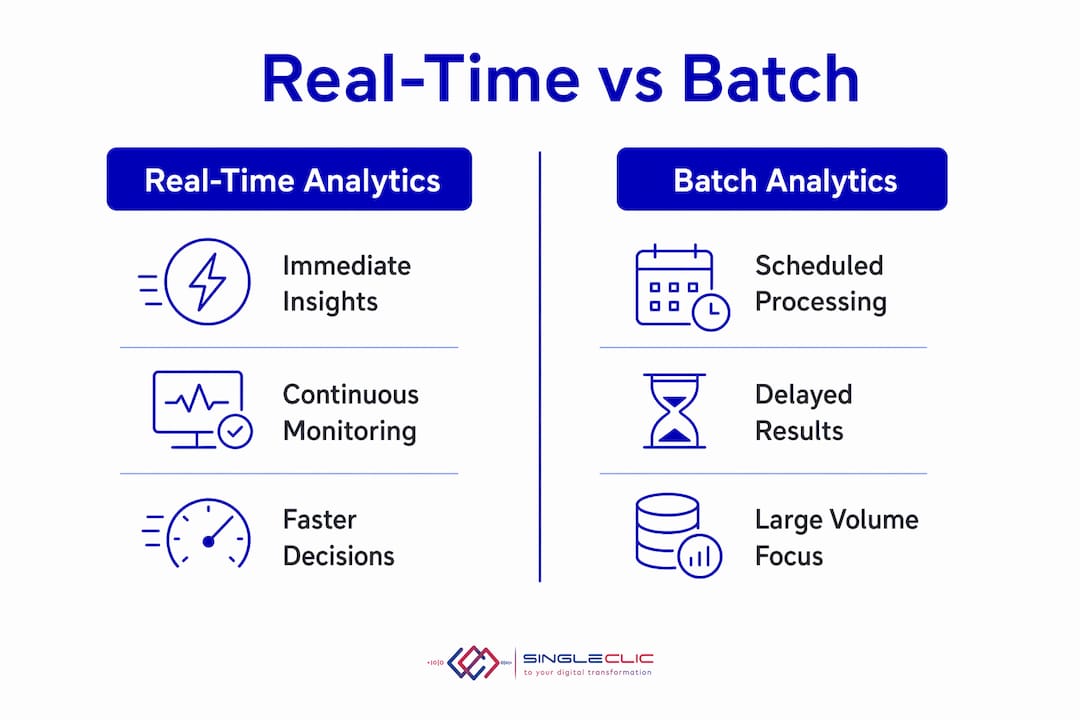
Real-time analytics and batch analytics solve the same problem in fundamentally different ways. Batch analytics collects data over a period, stores it, and then runs queries against that stored dataset on a schedule. The result is insights that are hours or even days old by the time they reach a decision-maker. Real-time analytics delivers insights within milliseconds to low seconds, making it possible to act while an event is still unfolding.

The architectural difference is significant. Batch systems rely on Extract, Transform, Load (ETL) pipelines that wait for a processing window to close before moving data. Real-time systems use streaming ingestion and continuous indexing on arrival, so data is queryable the moment it enters the system. There is no waiting. There is no window.
| Characteristic | Real-time analytics | Batch analytics |
|---|---|---|
| Latency | Milliseconds to seconds | Minutes to hours or days |
| Data ingestion | Continuous streaming | Scheduled ETL windows |
| Query model | Continuous incremental processing | Periodic bulk queries |
| Best for | Fraud detection, live dashboards, personalization | Historical reporting, end-of-period analysis |
| Infrastructure | Specialized analytical databases | Traditional data warehouses |
The core components of a real-time architecture include an event streaming platform for ingestion, an analytical database optimized for sub-second queries, and a query engine that can handle many concurrent requests without degrading. Event streaming platforms like Kafka are the most widely adopted ingestion layer because they handle high-throughput data from multiple sources simultaneously.
- Streaming ingestion: Data flows continuously from sources such as web applications, IoT sensors, or transaction systems into the pipeline.
- Continuous incremental processing: Each new event updates the analytical state immediately rather than waiting for a batch job to run.
- Sub-second query engines: Specialized databases serve query results in milliseconds even under high concurrency.
- Live dashboards and alerts: The output layer surfaces insights to analysts and systems the moment thresholds are crossed.
Pro Tip: If your team is evaluating real-time analytics architecture, check whether your current database was built for historical queries or for high-concurrency, low-latency workloads. The distinction determines whether you need a new tool or a new system entirely.
What are the key business benefits of real-time analytics?
The most direct benefit of real-time analytics is faster, better-informed decisions. When a customer service agent can see a customer’s last three interactions, current cart value, and churn risk score in a single live view, the conversation changes. The agent stops reacting and starts guiding.
Real-time analytics powers critical use cases including fraud detection, personalized recommendations, and operational monitoring, where delayed action means lost revenue or direct financial harm. A bank that detects a suspicious transaction pattern within two seconds can block a fraudulent charge before it clears. A bank that runs nightly batch reports finds out the next morning.
“Real-time data analysis replaces delayed post-storage insights with immediate insights that help teams act on streaming events while they are still actionable.” — Bernard Marr
The benefits extend beyond individual transactions. User-facing applications powered by real-time analytics require high-performance, low-latency architectures that serve many concurrent users without slowing down. This means real-time analytics is no longer just an internal reporting tool. It is the engine behind the personalized product recommendations you see on an e-commerce site and the live inventory counts that prevent overselling.
Key business benefits include:
- Operational agility: Teams respond to supply chain disruptions, demand spikes, or system failures in real time rather than after the fact.
- Revenue protection: Fraud detection and anomaly monitoring catch problems before they cause financial damage.
- Customer experience: Personalized offers and recommendations are served at the right moment in the customer journey.
- Employee effectiveness: Frontline staff make better decisions when they have current data, not yesterday’s report.
- Competitive differentiation: Organizations that act on live data consistently outpace those waiting for batch reports to close.
Why real-time analytics is an organizational challenge, not just a technical one
The biggest misconception about real-time analytics is that buying the right technology solves the problem. MIT Sloan defines “real-time-ness” as an organizational capability that combines digitized operations, empowered employees, real-time data access, and governance guardrails. Technology is one component. Culture and structure are the others.
Empowered employees are central to this definition. A real-time dashboard has no value if the person looking at it must escalate every decision through three layers of management before acting. Organizations that succeed with real-time analytics give frontline teams the authority to act on what they see. They also build governance guardrails so that authority is exercised within defined boundaries, protecting data quality and compliance.
Common failure patterns are predictable. Teams treat real-time analytics as a pure IT project, deploy a streaming platform, and then find that no one changes how decisions are made. The data flows faster, but the organization still waits for the weekly review meeting. That gap between data speed and decision speed is where the performance premium disappears.
Pro Tip: Before scaling real-time capabilities across your organization, identify two or three high-value use cases where speed of insight directly translates to revenue or cost impact. Prove the model there first, then expand.
How to implement real-time analytics: best practices and common mistakes
Successful implementation starts with the right infrastructure choice. Traditional BI stacks often fail at real-time workloads because they were built for historical, structured data and batch query models. Forcing real-time requirements onto a legacy data warehouse produces slow queries, high costs, and frustrated analysts. Specialized analytical databases designed for sub-second, high-concurrency queries are the correct foundation.
The second critical decision is use case focus. Targeted high-value use cases produce faster adoption and clearer ROI than enterprise-wide rollouts. Start with fraud monitoring, live operational dashboards, or customer personalization. Each of these has a measurable outcome tied directly to data latency. Once you prove value in one area, the organizational appetite for broader adoption grows naturally.
Integration with existing workflows matters as much as the technology itself. Real-time analytics that lives in a standalone tool and never connects to your CRM, ERP, or operational systems creates another data silo. The goal is to surface live insights inside the tools your teams already use, whether that is a live operational dashboard or an automated alert inside your workflow platform.
| Best practice | Common mistake |
|---|---|
| Use specialized analytical databases | Force real-time queries onto a legacy data warehouse |
| Start with focused, high-value use cases | Attempt enterprise-wide rollout from day one |
| Empower employees to act on live data | Require hierarchical approval for every real-time decision |
| Build governance guardrails from the start | Treat governance as a post-launch concern |
| Integrate insights into existing operational tools | Keep real-time analytics in a separate, standalone dashboard |
For teams in Saudi Arabia and the UAE, where regulatory compliance and data residency requirements add complexity, on-premise or hybrid architectures are often the right starting point. Singleclic’s Cortex platform supports real-time process optimization with on-premise deployment, which addresses both performance and compliance requirements for banks and government organizations in the MENA region.
Key Takeaways
Real-time analytics delivers competitive advantage only when fast data infrastructure is matched by empowered employees and clear governance, not technology alone.
| Point | Details |
|---|---|
| Definition and latency | Real-time analytics delivers insights within milliseconds to seconds, compared to hours or days for batch processing. |
| Performance premium | Companies with top-quartile real-time capability achieve over 50% higher revenue growth and net margins. |
| Architecture requirement | Streaming ingestion with specialized analytical databases is required; traditional BI stacks cannot handle real-time workloads. |
| Organizational capability | Empowered employees and governance guardrails are as critical as the technology itself. |
| Implementation approach | Start with two or three high-value use cases before scaling real-time capabilities organization-wide. |
Real-time analytics is a leadership decision, not just a data decision
I have worked with organizations across the MENA region that had excellent data infrastructure and still made slow decisions. The bottleneck was never the database. It was the approval chain.
What I have observed consistently is that the companies extracting the most value from real-time decision-making are the ones where senior leaders actively redesigned how decisions get made, not just how data gets processed. They asked: “If our team had this information in two seconds instead of two days, what would we need to change about our operating model?” That question changes everything.
The shift from batch to real-time analytics is not primarily a technology upgrade. It is a commitment to operating at a different speed. Organizations that treat it as a software purchase miss the point entirely. The ones that treat it as a leadership initiative, with technology as the enabler, are the ones showing up in the top quartile of that MIT Sloan research.
My advice to business analysts and decision-makers is direct: do not wait for your organization to be “ready” for real-time analytics. Pick one use case where speed of insight has a clear dollar value, build the capability there, and show the result. That proof point does more to accelerate adoption than any enterprise-wide strategy document.
— Tamer Badr
How Singleclic supports real-time analytics for MENA enterprises
Singleclic integrates data across Microsoft Dynamics 365, Odoo, and enterprise systems to give decision-makers in Saudi Arabia, the UAE, and Egypt a live view of operations, not a delayed one.
Through Microsoft Dynamics 365 and the Cortex low-code platform, Singleclic connects ERP, CRM, and operational data into unified dashboards that update in real time. Cortex supports runtime workflow changes without downtime, which means your processes adapt as fast as your data does. For organizations in banking, healthcare, and government that need on-premise deployment, Cortex delivers real-time process optimization without compromising data residency requirements. If you are ready to move from historical reporting to live decision-making, explore Singleclic’s Dynamics 365 solutions as the foundation for your real-time analytics capability.
FAQ
What is real-time analytics in simple terms?
Real-time analytics is the process of analyzing data the moment it is created, delivering insights within milliseconds to seconds so teams can act immediately rather than waiting for batch reports.
How does real-time analytics differ from batch analytics?
Batch analytics processes data in scheduled intervals, producing insights that are hours or days old. Real-time analytics uses continuous streaming ingestion to make data queryable the instant it arrives.
What are the most common real-time analytics use cases?
Fraud detection, personalized product recommendations, live operational monitoring, and customer experience optimization are the most widely deployed use cases because each requires immediate action on current data.
What technology does real-time analytics require?
Real-time analytics requires a streaming ingestion platform such as Kafka, a specialized analytical database optimized for sub-second queries, and a query engine capable of handling high concurrency without performance degradation.
Why do real-time analytics projects fail?
Most failures occur when organizations treat real-time analytics as a pure technology project without redesigning decision-making authority. Fast data paired with slow approval chains produces no measurable improvement in outcomes.