Across Saudi Arabia and UAE, CIOs and CTOs face constant pressure to deliver measurable performance gains in high-stakes sectors like healthcare and construction. Aligning Key Performance Indicators within modern ERP systems has become the foundation for transforming raw data into strategic intelligence. By focusing on well-defined KPIs, enterprise leaders gain timely insights, foster agile responses, and build a culture of continuous improvement essential for sustained operational optimization.
Table of Contents
- Defining KPIs Within Modern ERP Systems
- Major KPI Types For Healthcare And Construction
- Integrating KPIs Into ERP For Actionable Insights
- Driving Operational Optimization With Targeted KPIs
- Common Challenges In KPI Implementation
Key Takeaways
| Point | Details |
|---|---|
| Importance of KPIs | KPIs are essential for evaluating organizational performance and aligning strategies with specific business goals. |
| Real-Time Integration | Integrating real-time KPI tracking within ERP systems enables organizations to quickly adapt to market changes. |
| Sector-Specific Needs | Different industries, like healthcare and construction, require tailored KPIs to address their unique operational characteristics. |
| Implementation Challenges | Successfully implementing KPIs involves overcoming user resistance, ensuring data quality, and providing adequate training for effective use. |
Defining KPIs Within Modern ERP Systems
Key Performance Indicators (KPIs) serve as critical navigational tools for organizations seeking strategic business optimization, particularly within Enterprise Resource Planning (ERP) systems. Performance metrics capturing critical business aspects enable decision-makers to evaluate and enhance organizational processes effectively.
Modern ERP systems leverage KPIs across multiple dimensions, providing comprehensive insights into organizational performance. These performance indicators typically encompass several strategic categories:
- Financial Performance indicators tracking revenue, profitability, and cost management
- Operational Efficiency metrics measuring process productivity and resource utilization
- Customer Satisfaction indicators evaluating service quality and engagement levels
- Employee Performance metrics assessing workforce productivity and skill development
- Supply Chain Management indicators monitoring inventory, procurement, and logistics effectiveness
Enterprise leaders in Saudi Arabia and UAE recognize that well-defined KPIs transform raw data into actionable intelligence. By integrating real-time performance tracking within ERP platforms like our Cortex low-code solution, organizations can dynamically adapt their strategies and respond rapidly to emerging business challenges.
KPIs are not just metrics; they represent the strategic pulse of an organization’s operational health and potential for growth.
Successful KPI implementation requires a systematic approach that aligns performance indicators with specific organizational goals. Businesses must carefully select metrics that directly reflect their unique strategic objectives, ensuring meaningful and contextually relevant insights.

Pro tip: Develop a balanced KPI framework by involving stakeholders from multiple departments to create holistic, interconnected performance measurement strategies.
Major KPI Types for Healthcare and Construction
Healthcare and construction industries require specialized Key Performance Indicators (KPIs) that capture the unique nuances of their operational ecosystems. Hospital performance evaluation indicators demonstrate the critical importance of comprehensive, multidimensional measurement strategies across different sectors.
In healthcare, KPIs are strategically categorized to provide holistic insights into organizational performance:
- Patient Care Quality indicators measuring treatment outcomes and patient satisfaction
- Operational Efficiency metrics tracking resource utilization and process optimization
- Clinical Performance indicators assessing medical team productivity and skill levels
- Financial Health metrics monitoring revenue, cost management, and budget performance
- Technological Adoption indicators evaluating digital transformation and innovation
Similarly, the construction industry demands a comprehensive approach to performance measurement. Construction performance metrics extend beyond traditional financial evaluations to encompass a broader range of critical indicators:
- Project Cost Management tracking budget adherence and financial efficiency
- Safety Performance indicators monitoring workplace incident rates and risk mitigation
- Quality Assurance metrics measuring project compliance and deliverable standards
- Sustainability Impact evaluating environmental considerations and green practices
- Technology Integration indicators assessing digital tool adoption and innovation
Effective KPI strategies transform raw data into actionable intelligence, enabling organizations to make informed, strategic decisions.
Enterprise leaders in Saudi Arabia and UAE recognize that carefully selected performance indicators can drive significant operational improvements. By leveraging advanced ERP platforms like our Cortex low-code solution, businesses can create dynamic, real-time performance tracking systems tailored to their specific industry requirements.
Pro tip: Develop industry-specific KPI frameworks that balance quantitative metrics with qualitative insights to create a more comprehensive performance evaluation approach.
The following table compares KPI categories in healthcare and construction industries to highlight their unique priorities:
| KPI Category | Healthcare Focus | Construction Focus |
|---|---|---|
| Quality Metrics | Patient care outcomes, satisfaction | Project compliance, deliverable standards |
| Financial Management | Revenue, budget performance | Budget adherence, cost efficiency |
| Innovation/Technology | Digital transformation, clinical tools | Digital tool adoption, process automation |
| Operational Efficiency | Resource utilization, process optimization | Schedule management, productivity |
| Safety/Sustainability | Patient safety, regulatory compliance | Incident rates, environmental impact |
Integrating KPIs Into ERP for Actionable Insights
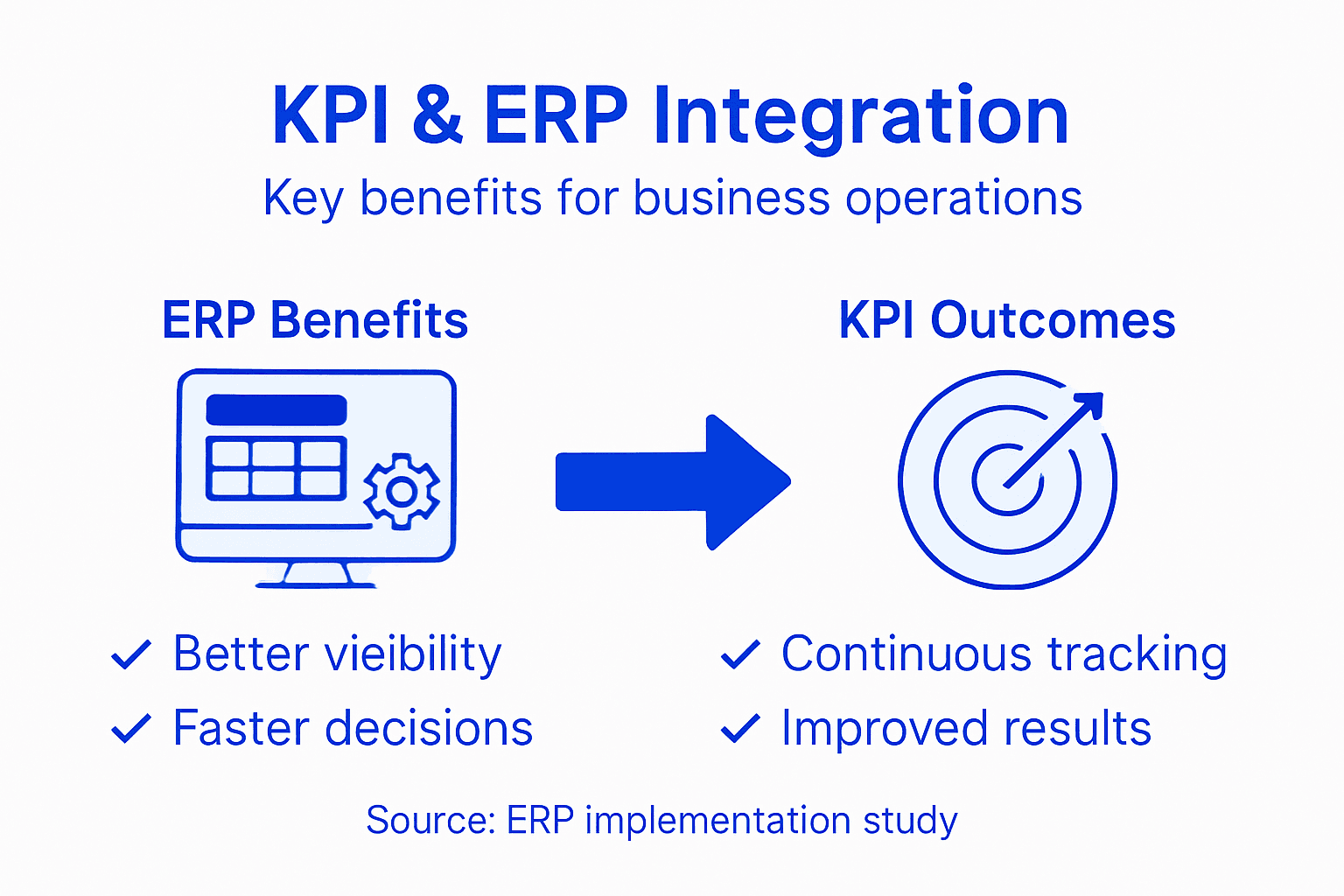
Modern enterprises recognize that strategic KPI integration transforms Enterprise Resource Planning (ERP) systems from mere operational tools into powerful decision-making platforms. The integration process requires a sophisticated approach that goes beyond simple data collection, focusing on creating meaningful, actionable insights that drive organizational performance.
Successful KPI integration into ERP systems involves multiple critical components:
- Data Alignment ensuring seamless connection between performance metrics and strategic objectives
- Real-Time Analytics enabling immediate insight generation and responsive decision-making
- Cross-Functional Visibility providing comprehensive organizational performance perspectives
- Customizable Dashboards allowing tailored visualization of key performance indicators
- Automated Reporting generating instant, accurate performance summaries
Enterprise Information Systems advancement highlights the importance of technological, organizational, and environmental factors in KPI integration. Organizations in Saudi Arabia and UAE are particularly focused on developing sophisticated ERP platforms like our Cortex low-code solution that enable dynamic performance tracking and optimization.
Effective KPI integration transforms raw data into strategic intelligence, empowering organizations to make informed decisions rapidly.
Enterprise leaders must approach KPI integration as a holistic strategy, recognizing that successful implementation requires more than technological solutions. It demands a comprehensive understanding of organizational goals, cultural readiness, and the ability to translate complex data into actionable insights.
Pro tip: Design KPI integration strategies that balance technological capabilities with human insights, ensuring that data-driven decisions remain contextually relevant and strategically aligned.
Here is a summary table outlining key benefits of integrating KPIs into ERP systems:
| Benefit | Description | Impact on Business |
|---|---|---|
| Real-Time Analytics | Instant insight generation for key metrics | Faster decision-making |
| Automated Reporting | Streamlined performance summaries | Saves staff time, reduces errors |
| Cross-Functional View | Unified perspective across departments | Fosters collaboration |
| Custom Dashboards | Personalized visualization for stakeholders | Supports role-specific actions |
Driving Operational Optimization With Targeted KPIs
Machine learning-driven optimization represents a transformative approach to enhancing operational efficiency through strategic KPI implementation. By leveraging advanced algorithms and real-time data analysis, organizations can create dynamic performance measurement systems that adapt and respond instantaneously to changing business environments.
Targeted KPI strategies for operational optimization typically encompass several critical dimensions:
- Predictive Performance Analysis enabling proactive decision-making
- Resource Allocation Optimization maximizing efficiency and minimizing waste
- Process Automation reducing manual intervention and human error
- Continuous Improvement Tracking identifying systemic enhancement opportunities
- Strategic Alignment Monitoring ensuring KPIs reflect organizational objectives
Operational performance enhancement requires a sophisticated approach that transcends traditional measurement techniques. Enterprise leaders in Saudi Arabia and UAE are increasingly adopting advanced ERP platforms like our Cortex low-code solution to create sophisticated, data-driven optimization frameworks that enable real-time strategic adaptation.
Targeted KPIs are not merely metrics, but strategic navigational tools that guide organizational transformation and competitive advantage.
Successful implementation demands a holistic perspective that integrates technological capabilities with deep organizational understanding. By carefully selecting and monitoring KPIs that reflect nuanced performance dimensions, businesses can create responsive, intelligent systems that drive continuous operational excellence.
Pro tip: Develop a dynamic KPI framework that balances quantitative measurements with qualitative insights, ensuring your performance tracking remains both comprehensive and contextually relevant.
Common Challenges in KPI Implementation
ERP and KPI implementation challenges represent complex organizational obstacles that require strategic and multifaceted approaches to overcome. Enterprise leaders must navigate intricate technological, cultural, and operational barriers that can significantly impede the successful deployment of performance measurement systems.
Key implementation challenges typically manifest across several critical dimensions:
- User Resistance preventing smooth technological adoption
- Technical Integration Complexities creating system interoperability issues
- Strategic Misalignment undermining organizational performance objectives
- Insufficient Training limiting effective system utilization
- Data Quality and Consistency compromising performance measurement accuracy
Critical failure factors in ERP implementation highlight the nuanced challenges faced by organizations in Saudi Arabia and UAE. Enterprise leaders must develop comprehensive strategies that address both technological and human factors to ensure successful KPI integration.
Overcoming KPI implementation challenges requires a holistic approach that balances technological innovation with organizational change management.
Successful navigation of these challenges demands a proactive, strategic approach that combines technological expertise, change management principles, and a deep understanding of organizational dynamics. By anticipating and addressing potential obstacles, businesses can create robust KPI implementation frameworks that drive meaningful performance improvements.
Pro tip: Develop a comprehensive change management strategy that includes stakeholder engagement, continuous training, and iterative feedback mechanisms to mitigate KPI implementation challenges.
Harness Real-Time KPI Optimization with Singleclic’s Cutting-Edge ERP Solutions
Modern enterprises face significant challenges in integrating KPIs within ERP systems to achieve real-time operational optimization. If you struggle with technical integration complexities, strategic misalignment, or need customizable dashboards that provide actionable insights instantly, this article highlights the critical need for dynamic, data-driven performance tools. Achieving seamless KPI integration demands not only technology but also a deep understanding of organizational goals and human factors.
Singleclic empowers organizations across KSA, UAE, and Egypt to overcome these exact challenges by delivering advanced ERP and low-code platform solutions like our Cortex platform. Cortex enables you to build real-time, intelligent KPI frameworks that drive continuous operational excellence with minimal coding effort and full Arabic support. Combining our expertise with world-class tools such as Odoo, Microsoft Dynamics 365, and IBM BAW, we help you transform fragmented data into strategic intelligence that accelerates growth and maximizes efficiency.
Take charge of your digital transformation by partnering with Singleclic today. Discover how our tailored ERP implementations and business process automation services can elevate your KPI integration and enable proactive, data-driven decisions. Visit Singleclic to learn more and start optimizing your enterprise performance now.
Frequently Asked Questions
What are the primary types of KPIs used in ERP systems?
Modern ERP systems utilize various KPIs across strategic categories, including financial performance, operational efficiency, customer satisfaction, employee performance, and supply chain management indicators.
How do KPIs enhance decision-making within an organization?
KPIs transform raw data into actionable insights, allowing decision-makers to evaluate processes efficiently, adapt strategies in real-time, and respond to emerging business challenges effectively.
What challenges can organizations face when implementing KPIs in ERP systems?
Organizations may encounter user resistance, technical integration complexities, strategic misalignment, insufficient training, and data quality issues that can hinder effective KPI implementation.
How can organizations ensure successful KPI integration into their ERP systems?
Successful KPI integration requires alignment of performance metrics with organizational goals, real-time analytics, cross-functional visibility, customizable dashboards, and thorough training for users.