Repetitive administrative tasks often slow progress for executive leaders in construction and banking across Saudi Arabia and UAE. Robotic Process Automation offers a practical solution by deploying digital robots that handle structured, rule-based work with speed and precision. Recognizing the difference between RPA and broader artificial intelligence is vital for making informed, strategic decisions. This exploration reveals how adopting RPA enhances efficiency, clarifies misconceptions, and positions your organization for measurable operational gains.
Table of Contents
- Defining RPA And Common Misconceptions
- Types Of RPA And Core Features Explained
- Sector-Specific Use Cases In Construction And Banking
- Implementing RPA: Integration And Workflow Impact
- Risks, Challenges, And Cost Considerations
- Success Factors And Best Practices For RPA
Key Takeaways
| Point | Details |
|---|---|
| Understanding RPA | RPA is a software technology that automates rule-based tasks without human intervention, distinct from artificial intelligence. |
| Types of RPA | RPA includes Attended, Unattended, and Hybrid Bots, each suitable for different operational needs and levels of human interaction. |
| Implementation Considerations | Successful RPA deployment requires comprehensive process analysis, stakeholder education, and alignment with organizational goals. |
| Risks and Management | Organizations must assess risks such as process knowledge erosion and hidden costs, implementing robust governance to mitigate these challenges. |
Defining RPA and Common Misconceptions
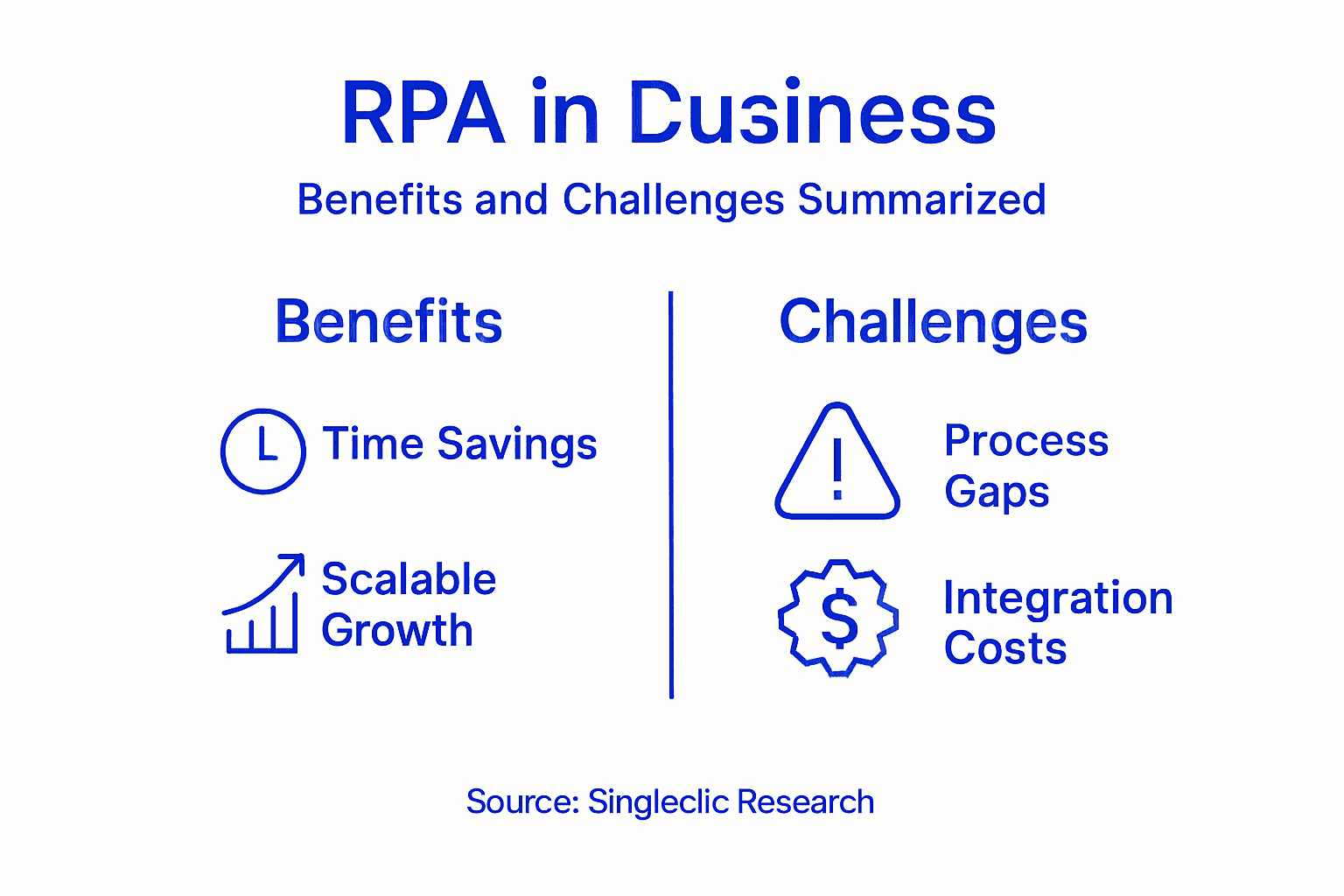
Robotic Process Automation (RPA) represents a transformative technology enabling businesses across Saudi Arabia and UAE to streamline repetitive operational tasks with unprecedented efficiency. At its core, RPA is a software-driven approach that creates digital robots capable of executing predefined workflows across multiple systems without human intervention.
Understanding RPA requires distinguishing it from broader automation technologies. Software robots in RPA fundamentally mimic human interactions with digital interfaces, performing rule-based tasks by following precise programmed instructions. Unlike artificial intelligence, RPA does not inherently learn or make complex decisions – it executes structured processes with mechanical precision.
Common misconceptions about RPA frequently emerge from misunderstanding its capabilities and scope. Key areas of confusion include:
- Believing RPA is equivalent to artificial intelligence
- Assuming RPA can handle unstructured or complex cognitive tasks
- Thinking RPA implementation is a quick technological fix
- Underestimating the importance of process standardization
Businesses in construction, banking, and government sectors across KSA and UAE must recognize that successful RPA deployment requires careful process analysis and strategic implementation. Our low-code platform Cortex enables organizations to design and automate workflows without extensive coding knowledge, making digital transformation more accessible.
The fundamental distinction lies in RPA’s operational mechanism. While traditional workflow automation relies on application programming interfaces (APIs), RPA interacts directly with user interfaces, mimicking human actions like mouse clicks, data entry, and screen navigation. This approach allows RPA to integrate seamlessly with existing systems without requiring complex backend modifications.
Pro tip: Before implementing RPA, conduct a comprehensive audit of your current processes to identify repetitive, rule-based tasks that are prime candidates for automation.
Types of RPA and Core Features Explained
Robotic Process Automation (RPA) has evolved into a sophisticated technology with multiple types and robust features designed to address complex business challenges across industries in Saudi Arabia and UAE. RPA technologies encompass diverse automation strategies that enable organizations to streamline operations and enhance productivity through intelligent software robots.
The primary types of RPA can be categorized based on their operational characteristics and interaction levels:
- Attended Bots: Collaborate directly with human workers, providing real-time assistance and guidance
- Unattended Bots: Operate autonomously in background systems without human intervention
- Hybrid Bots: Combine attended and unattended capabilities for flexible process automation
Core features of modern RPA solutions have expanded significantly beyond basic task execution. These advanced capabilities include:
Here’s how the main types of RPA differ in functionality and business impact:
| Type of RPA | Human Interaction Level | Best Use Cases | Business Impact |
|---|---|---|---|
| Attended Bots | High | Customer service | Improves responsiveness |
| Unattended Bots | None | Back-office tasks | Reduces labor costs |
| Hybrid Bots | Moderate | Complex workflows | Enhances flexibility |
- Continuous monitoring and real-time performance tracking
- Adaptive logic and machine learning integration
- Comprehensive dashboard and queue management systems
- Scalable orchestration across multiple organizational platforms
- Enhanced auditability and standardized process documentation
Businesses in construction, banking, and government sectors can leverage these RPA types to address specific operational challenges. Our low-code platform Cortex provides flexible deployment options that enable organizations to design custom automation workflows tailored to their unique requirements.

The strategic implementation of RPA goes beyond simple task automation. By integrating sophisticated monitoring tools and adaptive technologies, organizations can create intelligent systems that not only execute repetitive tasks but also provide valuable insights and operational intelligence.
Pro tip: Conduct a comprehensive process audit to identify the most suitable RPA type for your specific organizational workflow and operational needs.
Sector-Specific Use Cases in Construction and Banking
Robotic Process Automation (RPA) has demonstrated transformative potential across critical industries in Saudi Arabia and UAE, with banking and construction sectors experiencing significant operational improvements through strategic implementation. Banking sector automation reveals compelling efficiency gains by addressing complex administrative challenges through intelligent software solutions.
In the banking sector, RPA delivers remarkable benefits through targeted automation strategies:
- Automated customer inquiry processing
- Compliance monitoring and risk management
- Real-time data entry and verification
- Fraud detection and transaction screening
- Streamlined account reconciliation processes
For construction industries, RPA introduces innovative approaches to manage complex project workflows:
- Automated safety documentation tracking
- Project lifecycle documentation management
- Resource allocation and scheduling optimization
- Digital compliance and reporting
- Supply chain and procurement process automation
Our low-code platform Cortex enables organizations to design customized RPA solutions that address sector-specific challenges, providing flexible deployment options tailored to unique operational requirements. By integrating advanced automation technologies, businesses can transform traditional manual processes into intelligent, efficient workflows.
RPA implementation requires careful process analysis and strategic alignment with organizational goals to maximize potential benefits and minimize disruption.
The strategic application of RPA goes beyond simple task automation, creating intelligent systems that provide comprehensive operational insights and drive continuous improvement across banking and construction ecosystems.
Pro tip: Develop a comprehensive change management strategy that includes workforce training and gradual RPA integration to ensure smooth technological adoption.
Implementing RPA: Integration and Workflow Impact
Implementing Robotic Process Automation (RPA) requires a strategic approach that goes beyond simple technological deployment, especially for organizations across Saudi Arabia and UAE seeking transformative operational improvements. Effective RPA integration demands comprehensive change management and a nuanced understanding of workflow dynamics.
Key considerations for successful RPA implementation include:
- Comprehensive stakeholder education and communication
- Detailed process selection and mapping
- Alignment with existing technological infrastructure
- Clear governance and monitoring frameworks
- Scalable integration strategies
The workflow impact of RPA extends far beyond immediate task automation, introducing profound organizational transformations:
- Redefining employee roles and responsibilities
- Creating more strategic human-automation interactions
- Enabling real-time performance tracking
- Reducing manual error rates
- Enhancing overall operational transparency
Our low-code platform Cortex provides organizations with flexible tools to design custom RPA solutions that seamlessly integrate with existing systems, minimizing disruption and maximizing technological adoption.
Successful RPA implementation is not about replacing humans, but about empowering them to focus on higher-value strategic tasks.
The strategic deployment of RPA requires balancing technological capabilities with human expertise, ensuring that automation enhances rather than undermines organizational effectiveness.
Pro tip: Develop a phased RPA implementation strategy that includes pilot testing, comprehensive training, and continuous feedback mechanisms to ensure smooth technological transition.
Risks, Challenges, and Cost Considerations
Robotic Process Automation (RPA) presents a complex landscape of potential risks and challenges that organizations in Saudi Arabia and UAE must carefully navigate to ensure successful implementation. RPA introduces multifaceted organizational risks that extend far beyond simple technological deployment.
Critical risks and challenges in RPA implementation include:
- Potential process knowledge erosion
- Security and control vulnerabilities
- Hidden implementation and maintenance costs
- Complex governance requirements
- Technology dependency and scalability limitations
Financial considerations for RPA adoption involve comprehensive evaluation of both direct and indirect expenses:
Below is a summary of key RPA risks, cost factors, and how organizations can address them:
| Category | Key Risk or Cost Factor | Mitigation Strategy |
|---|---|---|
| Operational | Process knowledge erosion | Documentation standards |
| Security | Data access vulnerability | Role-based permissions |
| Financial | Unexpected maintenance costs | Long-term budgeting |
| Strategic | Technology dependency | Scalable implementation |
- Initial software and infrastructure investment
- Training and change management costs
- Ongoing maintenance and upgrade expenses
- Potential productivity disruption during transition
- Long-term return on investment calculation
Our low-code platform Cortex provides organizations with transparent tools to assess and mitigate RPA implementation risks, offering flexible solutions that align with specific organizational needs and budget constraints.
Successful RPA adoption requires a holistic approach that balances technological potential with rigorous risk management strategies.
Organizations must develop robust governance frameworks that account for technological, regulatory, and operational dimensions to safeguard the integrity and effectiveness of RPA deployments.
Pro tip: Conduct a comprehensive risk assessment and develop a phased implementation strategy that includes continuous monitoring and adaptability mechanisms.
Success Factors and Best Practices for RPA
Successful Robotic Process Automation (RPA) implementation demands a strategic and holistic approach tailored to the unique organizational contexts of businesses in Saudi Arabia and UAE. Structured RPA program design emerges as a critical success factor for achieving sustainable digital transformation.
Key success factors for RPA implementation include:
- Clear organizational vision and strategic alignment
- Comprehensive stakeholder education and engagement
- Careful process selection for automation
- Robust governance and performance measurement frameworks
- Continuous learning and adaptability
Best practices for effective RPA deployment encompass multiple strategic dimensions:
- Establishing cross-functional collaboration teams
- Identifying high-value processes for initial automation
- Developing comprehensive training programs
- Creating transparent communication channels
- Implementing continuous monitoring mechanisms
Our low-code platform Cortex empowers organizations to navigate these implementation complexities by providing flexible tools that support seamless RPA integration and organizational readiness.
Successful RPA adoption is not about technological implementation, but about creating a culture of continuous improvement and strategic innovation.
Effective RPA implementation requires a nuanced understanding of organizational dynamics, with a focus on building institutional knowledge and maintaining adaptable technological ecosystems.
Pro tip: Develop a phased RPA implementation roadmap that prioritizes pilot projects, includes comprehensive change management strategies, and establishes clear performance metrics.
Unlock True Business Efficiency with RPA and Cortex
The article highlights critical challenges every organization faces when adopting Robotic Process Automation such as understanding RPA’s capabilities, selecting the right type of bots, and integrating automation smoothly into workflows. You want to move past digitalization and into real optimization by eliminating repetitive tasks, reducing errors, and scaling efficiently without overwhelming your teams or IT infrastructure.
At Singleclic, we understand these pain points deeply. Our expertise in Business Process Automation with IBM BAW & BonitaSoft and Robotic Process Automation with UiPath is designed to help businesses across Saudi Arabia, UAE, and Egypt overcome these very hurdles. Leveraging our Arabic-enabled low-code platform, Cortex, organizations can build, automate, and optimize workflows with no coding required, enabling real-time improvements and full integration with existing enterprise systems.
Experience how Cortex can be the brain of your business by empowering your teams to collaborate smarter and scale faster. Visit Singleclic today to explore how our end-to-end solutions in ERP & CRM Implementation and intelligent automation can accelerate your RPA journey and drive measurable growth. Don’t wait to transform your operations; start your path to efficiency and scalability now.
Frequently Asked Questions
What is Robotic Process Automation (RPA)?
Robotic Process Automation (RPA) is a software-driven technology that creates digital robots capable of executing repetitive operational tasks across multiple systems without human intervention.
How does RPA differ from artificial intelligence?
RPA mimics human actions to execute structured, rule-based tasks but does not possess the learning capabilities or decision-making abilities associated with artificial intelligence.
What are the different types of RPA bots?
The main types of RPA bots include attended bots, which work alongside humans, unattended bots that operate autonomously, and hybrid bots that combine both capabilities for flexible automation.
What are the benefits of implementing RPA in a business?
Implementing RPA can drive efficiency by reducing manual error rates, improving operational transparency, and freeing up human employees to focus on higher-value tasks.