Choosing the best ERP model has become more complex as organizations in Saudi Arabia and United Arab Emirates embrace rapid digital change. While American enterprises report over 60 percent adoption of cloud ERP, local healthcare and banking sectors face tougher regulatory and data sovereignty challenges. Understanding the core differences between cloud and on-premise ERP can empower CIOs and IT managers to boost operational efficiency, strengthen compliance, and prepare for sustained growth.
Table of Contents
- Defining Cloud ERP and On-Premise Models
- Core Differences in Deployment and Access
- Key Security and Data Governance Challenges
- Compliance in MENA Healthcare and Banking
- Cost Structures and Total Ownership Factors
- Choosing the Right ERP for Your Organization
Key Takeaways
| Point | Details |
|---|---|
| Deployment Differences | Cloud ERP offers external access and scalability, while On-Premise ERP provides internal control but requires significant investment and maintenance. |
| Cost Structure | Cloud ERP typically involves predictable subscription fees, whereas On-Premise ERP requires substantial upfront capital for infrastructure. |
| IT Management | Cloud solutions reduce the need for extensive internal IT staffing, while On-Premise systems necessitate larger IT teams for management and maintenance. |
| Regulatory Compliance | Organizations in regulated sectors should assess which ERP model aligns with their compliance requirements, as each presents unique challenges. |
Defining Cloud ERP and On-Premise Models
Understanding Enterprise Resource Planning (ERP) deployment models is crucial for organizations in Saudi Arabia and the United Arab Emirates seeking optimal technological infrastructure. Cloud ERP and On-Premise ERP represent two distinctly different approaches to managing business software and operations. Cloud computing services are transforming business models by offering flexible technological solutions tailored to organizational needs.
Cloud ERP represents a software delivery model where enterprise applications are hosted externally and accessed through internet-connected platforms. Organizations pay a subscription fee and receive continuous updates, scalable resources, and reduced infrastructure maintenance. In contrast, On-Premise ERP involves software installed directly on a company’s internal servers, providing complete control and customization but requiring significant upfront investment and ongoing technical management.
The primary differences between these models encompass several key dimensions:
- Deployment Location: Cloud ERP operates on external servers, while On-Premise ERP runs on company-owned infrastructure
- Cost Structure: Cloud solutions typically involve monthly subscriptions, whereas On-Premise models require substantial initial capital expenditure
- Maintenance Responsibility: Cloud providers manage system updates and security, while internal IT teams handle On-Premise system maintenance
- Scalability: Cloud ERP offers rapid, flexible scaling, unlike the more rigid On-Premise infrastructure
Pro Tip: When evaluating ERP models, conduct a comprehensive total cost of ownership analysis that considers not just initial implementation expenses, but long-term operational and maintenance costs.
The table below provides an at-a-glance comparison of business impacts for Cloud ERP versus On-Premise ERP across critical dimensions:
| Dimension | Cloud ERP Impact | On-Premise ERP Impact |
|---|---|---|
| Agility | Accelerates digital growth | Slower adaptation to change |
| IT Staffing | Reduces need for specialists | Requires larger IT team |
| System Updates | Automatic and seamless | Manual, often delayed |
| Disaster Recovery | Provider-managed backups | Custom internal solutions |
Core Differences in Deployment and Access
Cloud and On-Premise ERP systems fundamentally differ in their deployment models, particularly in how organizations access, manage, and control their enterprise software infrastructure. On-premise ERP systems are deployed locally with unique characteristics that distinguish them from cloud-based alternatives, especially for enterprises in Saudi Arabia and the United Arab Emirates seeking robust technological solutions.
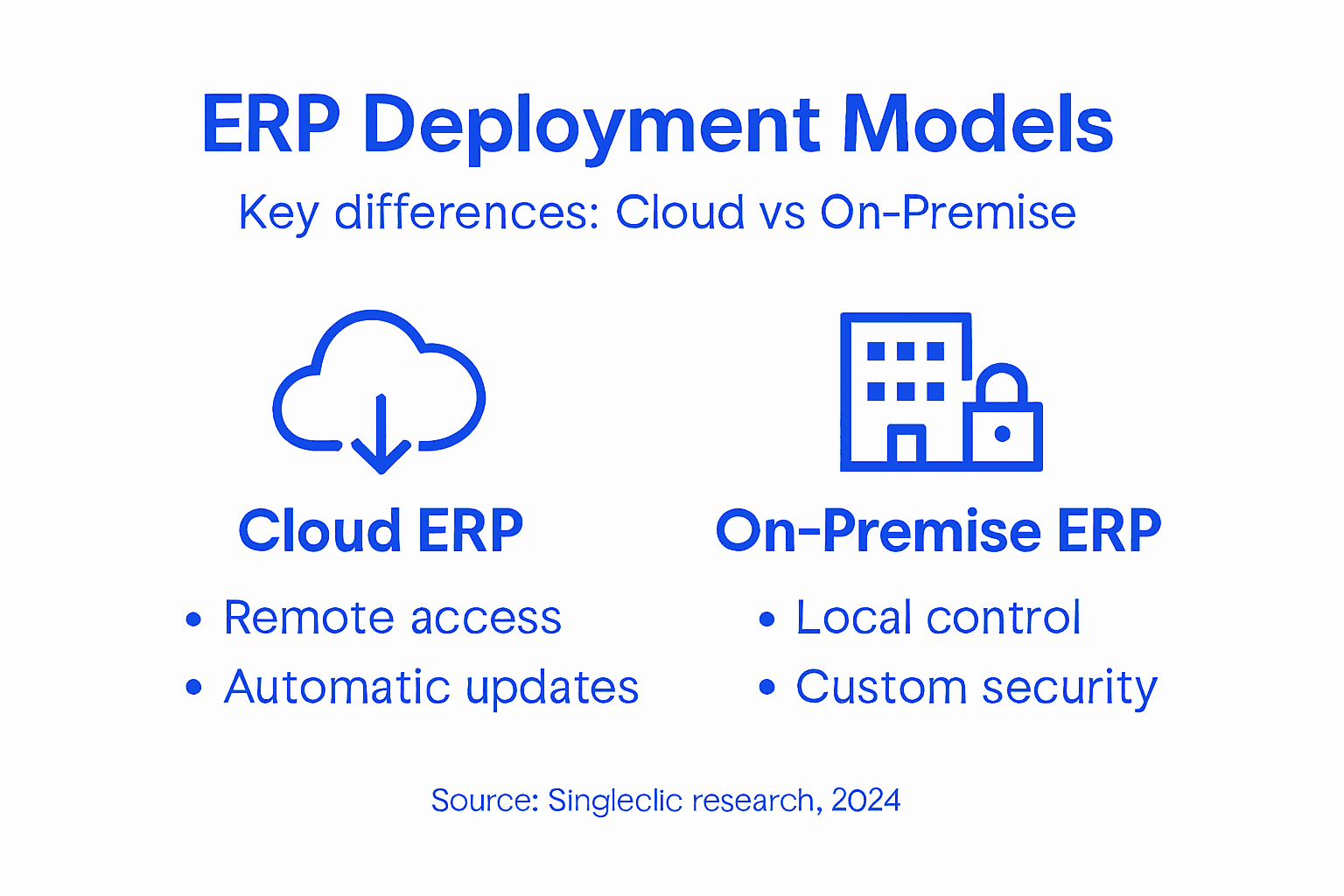
The deployment model significantly impacts an organization’s operational flexibility, cost structure, and technological capabilities. Local Installation defines on-premise ERP, where software is installed directly on a company’s internal servers, providing complete control over system configuration, data security, and upgrade processes. Cloud ERP, conversely, operates as a software-as-a-service (SaaS) model, hosted externally and accessed through internet-connected platforms with automatic updates and scalable resources.
Key deployment differences include:
- Infrastructure Requirements
- On-Premise: Demands physical server infrastructure, dedicated IT personnel
- Cloud: Minimal local infrastructure, provider-managed hardware
- Accessibility
- On-Premise: Limited to internal network, potential remote access challenges
- Cloud: Global accessibility, seamless remote work capabilities
- Security Management
- On-Premise: Direct internal control, customizable security protocols
- Cloud: Provider-managed security, standardized protection mechanisms
- Scalability
- On-Premise: Manual resource allocation, complex expansion
- Cloud: Instant resource adjustment, elastic computing capabilities
Pro Tip: Conduct a comprehensive infrastructure audit to determine which deployment model aligns most closely with your organization’s specific technological requirements and growth strategies.
Key Security and Data Governance Challenges
In the complex technological landscape of the Middle East, organizations face significant security and data governance challenges when selecting between cloud and on-premise ERP systems. Cloud computing security concerns center on critical risks that demand comprehensive risk management strategies, particularly for enterprises in Saudi Arabia and the United Arab Emirates navigating stringent regulatory environments.

The primary security challenges emerge from fundamental differences in infrastructure and data management approaches. Data Protection becomes paramount, with cloud ERP introducing multi-tenancy risks where shared infrastructure potentially exposes sensitive information. On-premise solutions offer direct control but require substantial internal security investments. Enterprises must carefully evaluate their risk tolerance, compliance requirements, and technological capabilities when selecting a deployment model that safeguards critical business data.
Key security and governance considerations include:
- Data Privacy Risks
- Cloud: Potential exposure in shared infrastructure
- On-Premise: Direct control but higher maintenance costs
- Compliance Challenges
- Cloud: Provider must meet regional regulatory standards
- On-Premise: Full internal compliance management
- Access Management
- Cloud: Centralized identity and authentication protocols
- On-Premise: Customizable but complex access controls
- Regulatory Alignment
- Cloud: Standardized security frameworks
- On-Premise: Flexible but resource-intensive compliance
Pro Tip: Implement a comprehensive security assessment framework that evaluates not just technological capabilities, but also aligns with your organization’s specific regulatory and operational requirements.
Compliance in MENA Healthcare and Banking
Healthcare and banking sectors in the Middle East represent some of the most complex regulatory environments for enterprise technology deployments, with each jurisdiction presenting unique compliance challenges. The MENA Cloud Alliance’s regulatory insights underscore the critical importance of understanding nuanced compliance requirements specific to Saudi Arabia, United Arab Emirates, and neighboring countries.
Regulatory Complexity demands sophisticated ERP solutions capable of adapting to rapidly evolving legal frameworks. Healthcare organizations must navigate patient data protection standards, while banking institutions face stringent financial reporting and cybersecurity regulations. The choice between cloud and on-premise ERP systems directly impacts an organization’s ability to maintain regulatory adherence, with each deployment model presenting distinct compliance advantages and challenges.
Key compliance considerations for MENA healthcare and banking include:
- Data Sovereignty
- Healthcare: Strict patient data localization requirements
- Banking: Cross-border transaction monitoring protocols
- Security Frameworks
- Healthcare: HIPAA and local patient privacy standards
- Banking: Basel III compliance and financial reporting regulations
- Authentication Protocols
- Healthcare: Multi-factor patient data access controls
- Banking: Advanced identity verification mechanisms
- Audit Trail Requirements
- Healthcare: Comprehensive treatment and patient interaction logs
- Banking: Detailed transaction tracking and reporting
Pro Tip: Develop a dynamic compliance mapping strategy that continuously tracks regulatory changes and automatically updates your ERP system’s configuration to maintain real-time regulatory alignment.
Cost Structures and Total Ownership Factors
Navigating the financial landscape of ERP deployment requires a nuanced understanding of complex cost considerations unique to the Middle Eastern market. Total Cost of Ownership analysis reveals critical financial implications) for organizations in Saudi Arabia and the United Arab Emirates seeking optimal technological investments.
Financial Complexity extends beyond simple hardware and software expenses, encompassing a comprehensive range of direct and indirect costs. Cloud and on-premise ERP systems present fundamentally different financial models, with cloud solutions offering predictable subscription-based pricing and on-premise systems demanding substantial upfront capital investments. Organizations must carefully evaluate their financial capabilities, technological requirements, and long-term strategic objectives when selecting an appropriate ERP deployment strategy.
Key cost considerations include:
- Initial Investment
- Cloud: Low upfront costs, subscription-based model
- On-Premise: Significant capital expenditure for hardware and infrastructure
- Operational Expenses
- Cloud: Predictable monthly operational costs
- On-Premise: Variable maintenance and upgrade expenses
- Scalability Costs
- Cloud: Easy resource scaling with incremental pricing
- On-Premise: Expensive infrastructure expansion
- Human Resource Allocation
- Cloud: Reduced internal IT management requirements
- On-Premise: Substantial ongoing technical personnel investment
Pro Tip: Conduct a comprehensive five-year total cost of ownership analysis that includes hidden expenses, potential productivity gains, and strategic technological flexibility.
Choosing the Right ERP for Your Organization
Selecting an appropriate Enterprise Resource Planning (ERP) system represents a critical strategic decision for organizations across Saudi Arabia and the United Arab Emirates. Selecting the right ERP involves comprehensive business assessment beyond simple technological compatibility, requiring deep understanding of organizational goals, operational complexity, and long-term digital transformation strategies.
Strategic Alignment becomes the cornerstone of effective ERP selection, demanding rigorous evaluation of cloud and on-premise solutions against specific organizational requirements. Enterprises must carefully analyze their technological maturity, compliance needs, financial constraints, and scalability expectations. Cloud ERP offers agility and lower initial investments, while on-premise systems provide granular control and customization potential, making the decision far more nuanced than a simple cost comparison.
Critical selection criteria include:
- Organizational Size
- Small/Medium: Cloud ERP recommended
- Large Enterprises: Hybrid or on-premise solutions preferred
- Industry Regulations
- Healthcare: Strict data governance requirements
- Banking: Advanced security and compliance needs
- IT Infrastructure
- Limited Internal Resources: Cloud solutions
- Robust IT Department: On-premise flexibility
- Budget Constraints
- Predictable Expenses: Cloud subscription models
- Long-term Investment: On-premise capital expenditure
Pro Tip: Create a comprehensive decision matrix that objectively scores potential ERP solutions across technical, financial, and strategic dimensions to ensure holistic evaluation.
Here is a summary of ERP selection priorities tailored for organizations in the Middle East:
| Selection Factor | Cloud ERP Preference | On-Premise ERP Preference |
|---|---|---|
| Rapid Expansion | Supports fast market entry | Expansion planning required |
| Regulatory Changes | Easier updates and adapts | Extensive reconfiguration needed |
| Integration Needs | API-driven connectivity | Full custom development required |
| Capital Expenditure | Optimized for cost control | Larger initial investment needed |
Navigate MENA Compliance Complexities with Expert ERP Solutions
Choosing between Cloud and On-Premise ERP presents a critical challenge for organizations in Saudi Arabia, United Arab Emirates, and the broader MENA region. The article highlights key concerns such as data sovereignty, stringent regulatory compliance, and the balance between agility and control. These complexities often create uncertainty about how to maintain security, optimize operational costs, and stay ahead of evolving regulations.
At Singleclic, we understand these challenges deeply. Our tailored approach combines industry-leading platforms like Odoo and Microsoft Dynamics 365 with advanced Business Process Automation and enterprise AI capabilities. We help you design and implement ERP solutions that precisely address data governance, regulatory alignment, and scalability requirements specific to healthcare, banking, construction, and government sectors in the Middle East.
Our on-premise enabled low-code platform Cortex is built specifically to meet MENA compliance demands — offering full Arabic UI, real-time workflow updates, and secure, on-premise deployments trusted by top financial and healthcare institutions. Let us empower your business to move beyond mere digitalization into effective optimization that enhances security and accelerates growth.
Explore how Singleclic can deliver your ideal Cloud or On-Premise ERP solution aligned with MENA regulations today. Visit our website to discover our comprehensive ERP & CRM Implementation services and learn why more than 60 enterprise clients trust us as their digital transformation partner. Take the next step toward compliance and operational excellence now.
Frequently Asked Questions
What are the main differences between Cloud ERP and On-Premise ERP in terms of compliance?
Cloud ERP operates with provider-managed security and standardized compliance frameworks, making it easier to adapt to regulatory changes. In contrast, On-Premise ERP offers full internal control but requires organizations to maintain compliance management themselves, often involving significant resources.
How does data sovereignty impact the choice between Cloud and On-Premise ERP systems?
Data sovereignty is a crucial factor as Cloud ERP may involve data being stored on shared infrastructure, which can raise privacy concerns. On-Premise ERP allows organizations to have complete control over their data location and security, which is vital for sectors with strict data localization requirements.
What are the security challenges associated with Cloud ERP compared to On-Premise ERP?
Cloud ERP systems face potential risks from shared infrastructure and multi-tenancy, which can expose sensitive data. On-Premise ERP provides direct control over security protocols but requires ongoing investment in technology and personnel to maintain a secure environment.
How do compliance requirements differ for industries like healthcare and banking when using Cloud vs On-Premise ERP?
Healthcare requires strict adherence to patient data protection laws, making On-Premise ERP attractive for its control over sensitive information. Meanwhile, banking institutions often have stringent cybersecurity standards, and Cloud ERP can facilitate easier compliance updates with centralized security frameworks.