Rising costs and increasing demands in Saudi Arabian and UAE healthcare settings are pushing technology leaders to rethink how patient care is delivered. Digital frameworks deliver more than simple digitization, creating holistic ecosystems that reshape both operational processes and the patient experience. For CIOs and CTOs, understanding the foundation and impact of these frameworks means tapping into the real potential of predictive analytics, interoperability, and governance to tackle daily healthcare challenges with smarter, agile solutions.
Table of Contents
- What Digital Frameworks Mean in Healthcare
- Types of Digital Frameworks and Their Uses
- Key Components Driving Operational Gains
- Implementation Challenges and Risk Controls
- Comparing Digital Frameworks With Legacy Systems
Key Takeaways
| Point | Details |
|---|---|
| Digital Frameworks Transformation | Digital frameworks are reimagining healthcare by integrating advanced technologies to improve patient care and operational efficiency. |
| Implementation Challenges | Organizations face challenges such as cybersecurity risks and digital literacy gaps, necessitating comprehensive risk management strategies. |
| Comparison with Legacy Systems | Digital frameworks offer seamless interoperability and scalability, contrasting with the limitations of traditional legacy systems. |
| Actionable Insights | Conduct technology readiness and maturity assessments to inform effective digital framework implementations and align with organizational goals. |
What Digital Frameworks Mean in Healthcare
Digital frameworks in healthcare represent sophisticated, interconnected systems designed to transform traditional medical operations through strategic technological integration. These comprehensive approaches go beyond simple digitization, creating holistic ecosystems that fundamentally reimagine patient care and organizational efficiency.
At their core, digital frameworks involve systematically applying advanced technologies to solve complex healthcare challenges. Digital transformation strategies enable healthcare organizations to address critical issues like rising treatment costs, chronic disease management, and operational inefficiencies. The frameworks typically incorporate multiple interconnected components:
- Predictive Analytics: Using data to anticipate patient needs and potential health risks
- Interoperability: Ensuring seamless communication between different healthcare systems and platforms
- Patient-Centered Technologies: Digital tools designed to enhance individual patient experiences
- Governance Structures: Robust protocols managing technological implementation and data management
In the Saudi Arabian and UAE healthcare contexts, digital frameworks are becoming increasingly critical. Organizations recognize that technological integration isn’t just about adopting new tools, but creating intelligent, responsive systems that can adapt to rapidly changing medical landscapes. Our low-code platform, Cortex, plays a significant role in enabling these transformative digital infrastructures by allowing healthcare providers to design complex workflows without extensive coding expertise.
Pro tip: Start your digital framework implementation by conducting a comprehensive technological readiness assessment to identify specific organizational needs and potential integration challenges.
Types of Digital Frameworks and Their Uses
Healthcare organizations are increasingly adopting diverse digital frameworks to address complex operational and patient care challenges. Digital health frameworks have evolved to support multiple specialized applications across medical ecosystems, transforming traditional healthcare delivery models.
These frameworks can be categorized into several distinct types, each serving unique strategic purposes:
- Telemedicine Frameworks: Enabling remote patient consultations and monitoring
- Electronic Medical Records (EMR) Systems: Centralizing and securing patient health information
- Artificial Intelligence Integration Frameworks: Supporting predictive diagnostics and personalized treatment plans
- Blockchain Healthcare Frameworks: Ensuring secure, transparent medical data exchanges
- Digital Health Equity Frameworks: Promoting inclusive healthcare access across diverse populations
In the context of Saudi Arabian and UAE healthcare systems, these digital frameworks are particularly critical. Regional healthcare leaders recognize that technological adoption goes beyond mere tool implementation, focusing instead on creating intelligent, adaptive systems that can respond dynamically to emerging medical challenges. Our low-code platform, Cortex, plays a pivotal role by enabling healthcare providers to rapidly design and deploy complex digital workflows without extensive technical expertise.
Digital frameworks represent more than technological solutions — they are strategic approaches to reimagining healthcare delivery and patient experience.
The technology adoption models demonstrate how digital frameworks can systematically assess and enhance organizational digital capabilities, providing a structured pathway for continuous technological evolution in healthcare settings.

Pro tip: Conduct a comprehensive digital maturity assessment before implementing any new healthcare framework to ensure alignment with your organization’s specific technological and operational requirements.
Key Components Driving Operational Gains
Healthcare organizations are experiencing transformative operational improvements through strategic digital framework implementation. Operational process optimization has become a critical priority for healthcare leaders seeking to enhance efficiency, reduce costs, and improve patient outcomes.
The key components driving these operational gains can be systematically categorized into several essential dimensions:
- Predictive Analytics: Leveraging data-driven insights for proactive decision-making
- Interoperability Systems: Enabling seamless communication across different healthcare platforms
- Workforce Digital Empowerment: Providing tools and training for technological adaptation
- Patient Engagement Technologies: Creating interactive and personalized healthcare experiences
- Robust Governance Structures: Establishing clear protocols for digital transformation
In the Saudi Arabian and UAE healthcare markets, these operational components are particularly significant. Healthcare leaders are increasingly recognizing that digital transformation is not just about implementing new technologies, but about creating intelligent, adaptive ecosystems that can respond dynamically to complex medical challenges. Our low-code platform, Cortex, plays a pivotal role by enabling healthcare providers to rapidly design and deploy sophisticated workflows without extensive technical expertise.
Operational gains are not just about technological implementation, but about creating intelligent systems that can evolve and adapt to changing healthcare landscapes.
The digital technology integration demonstrates how strategic technological adoption can dramatically improve resource allocation, communication efficiency, and overall service delivery speed in healthcare settings.
Pro tip: Develop a comprehensive digital maturity roadmap that aligns technological investments with your organization’s specific operational objectives and patient care strategies.
Implementation Challenges and Risk Controls
Healthcare digital transformation is a complex journey fraught with multifaceted challenges that demand strategic and nuanced approaches. Digital health implementation challenges represent critical barriers that healthcare organizations must systematically address to ensure successful technological integration.
The primary implementation challenges can be categorized into several key dimensions:
- Organizational Resistance: Cultural inertia and traditional workflow preferences
- Cybersecurity Vulnerabilities: Protecting sensitive patient data and system integrity
- Digital Literacy Gaps: Insufficient technological skills among healthcare professionals
- Regulatory Compliance: Navigating complex healthcare technology regulations
- Financial Constraints: Limited budgets for comprehensive digital transformation
In the Saudi Arabian and UAE healthcare landscapes, these challenges are particularly pronounced. Healthcare leaders must develop sophisticated risk mitigation strategies that go beyond simple technological implementation. Our low-code platform, Cortex, addresses many of these challenges by providing flexible, user-friendly tools that can be rapidly deployed with minimal technical expertise.
The following table summarizes common implementation challenges and practical risk control approaches:
| Challenge | Risk Control Strategy | Potential Outcome |
|---|---|---|
| Organizational Resistance | Staff training and communication | Improved user adoption |
| Cybersecurity Risks | Data encryption and frequent audits | Enhanced system security |
| Digital Literacy Gaps | Ongoing digital education programs | Skilled, tech-ready workforce |
| Regulatory Compliance | Regular legal consultation and documentation | Avoidance of regulatory penalties |
| Financial Constraints | Phased implementation and budget planning | Sustainable digital investment |
Successful digital framework implementation requires a holistic approach that balances technological innovation with robust risk management strategies.
User acceptance strategies demonstrate the critical importance of involving end-users in technology design and validation processes, ensuring that digital solutions meet real-world healthcare needs.
Pro tip: Develop a comprehensive change management strategy that includes ongoing staff training, transparent communication, and incremental technological integration to minimize organizational resistance.
Comparing Digital Frameworks With Legacy Systems
Healthcare technological evolution demands a critical examination of how digital frameworks fundamentally transform traditional system architectures. Digital healthcare transformation represents a paradigm shift from rigid, isolated legacy systems to dynamic, interconnected technological ecosystems.
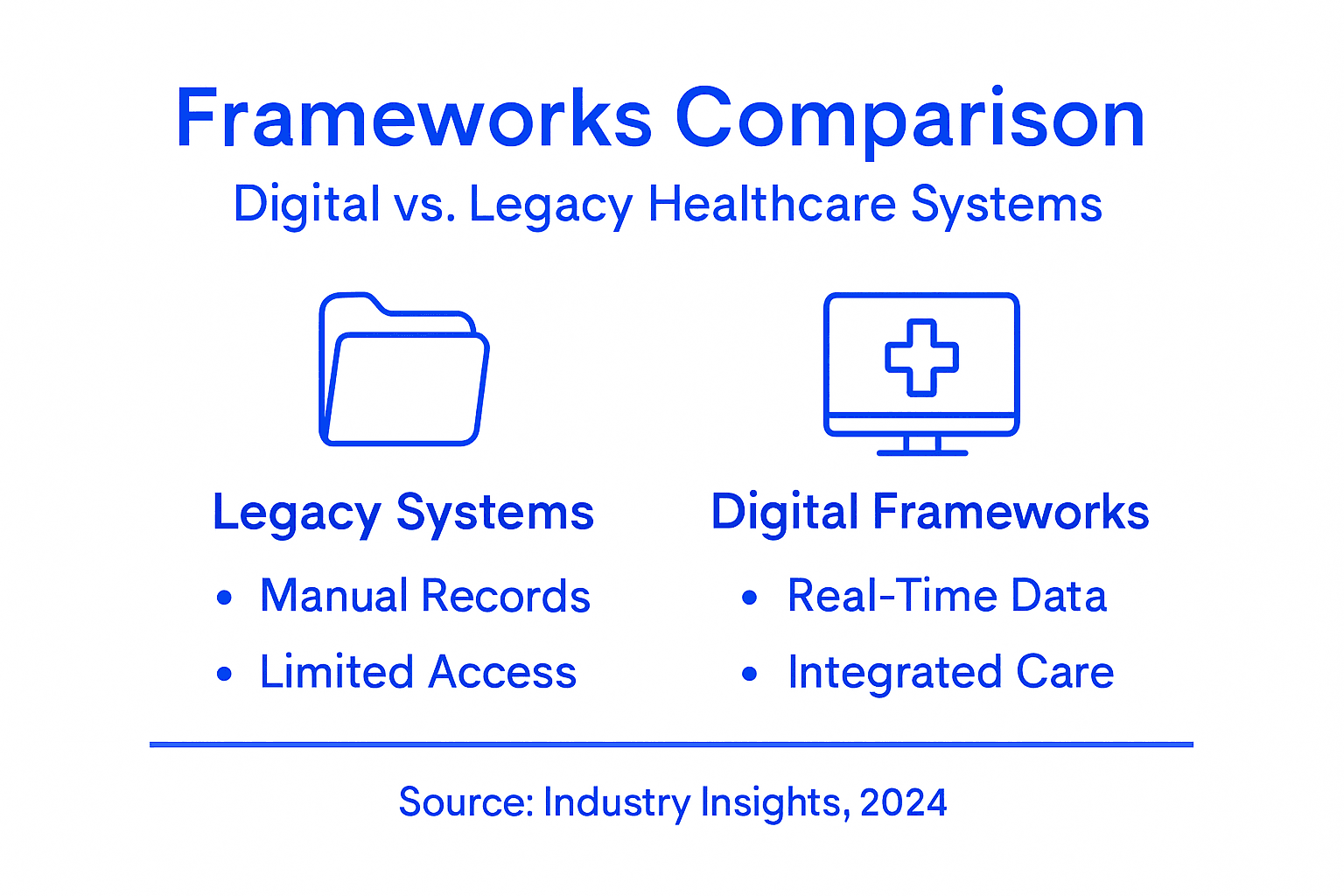
The key differences between digital frameworks and legacy systems can be systematically analyzed across multiple dimensions:
Here is a quick comparison of digital frameworks versus legacy systems in healthcare:
| Aspect | Digital Frameworks | Legacy Systems |
|---|---|---|
| Data Sharing | Seamless, real-time interoperability | Isolated, manual transfer |
| Scalability | Easily expandable to new functions | Limited by rigid infrastructure |
| Patient Experience | Personalized, tech-driven care | Generic, paper-based processes |
| Analytics Capability | Predictive and real-time insights | Basic, retrospective reporting |
| Adaptability | Continually updated and improved | Rare upgrades, often obsolete |
- Data Interoperability: Digital frameworks enable seamless information sharing
- Scalability: Modern systems offer flexible, expandable infrastructures
- Real-time Analytics: Advanced predictive capabilities replacing static reporting
- Patient-Centered Design: Personalized experiences versus generic interactions
- Technological Adaptability: Continuous innovation versus technological stagnation
In the Saudi Arabian and UAE healthcare markets, this transformation is particularly critical. Healthcare leaders recognize that digital frameworks are not merely technological upgrades but fundamental reimaginings of care delivery models. Our low-code platform, Cortex, exemplifies this approach by providing healthcare organizations with agile, customizable tools that transcend traditional system limitations.
Legacy systems represent technological museums, while digital frameworks are living, evolving organisms of healthcare innovation.
Healthcare system connectivity demonstrates how modern digital frameworks support comprehensive, integrated care models that legacy systems simply cannot match.
Pro tip: Conduct a comprehensive gap analysis between your current legacy systems and potential digital frameworks to identify precise transformation pathways and potential integration challenges.
Accelerate Healthcare Efficiency with Singleclic’s Digital Solutions
The article highlights that healthcare organizations face complex challenges such as interoperability issues, cybersecurity risks, and the need for adaptive, scalable digital frameworks that enhance patient care and operational efficiency. If you are aiming to transform your healthcare operations with seamless data integration, predictive analytics, and patient-centered technologies, the journey requires a strategic, technology-driven partner who understands these critical pain points.
At Singleclic, we specialize in empowering healthcare providers across Saudi Arabia, UAE, and Egypt to embrace true digital optimization—not just simple digitalization. Our low-code platform Cortex enables rapid design and deployment of sophisticated workflows without extensive coding. Cortex supports real-time process optimization, deep enterprise integration, and Arabic UI/UX to meet region-specific needs while ensuring strong governance and security. Beyond Cortex, our expertise in ERP/CRM implementation, Business Process Automation, and AI solutions creates a comprehensive framework to address operational gains and risk controls discussed in the article.
Are you ready to leave behind legacy systems and outdated processes? Explore how Singleclic can help you build scalable, adaptive digital frameworks that future-proof your healthcare organization’s success.
Unlock the full potential of your healthcare operations today with Singleclic’s proven technology and deep regional expertise. Visit Singleclic’s website to start your digital transformation journey or learn more about our low-code platform Cortex. Take the vital next step to elevate healthcare efficiency now.
Frequently Asked Questions
What are digital frameworks in healthcare?
Digital frameworks in healthcare are interconnected systems designed to enhance medical operations through technology integration, fundamentally improving patient care and organizational efficiency.
How do digital frameworks address operational inefficiencies in healthcare?
Digital frameworks utilize advanced technologies like predictive analytics and interoperability to streamline processes, reduce costs, and enhance overall patient outcomes.
What are some key components of digital frameworks in healthcare?
Key components include predictive analytics, interoperability systems, patient engagement technologies, and robust governance structures that collectively enhance healthcare delivery.
What challenges might healthcare organizations face when implementing digital frameworks?
Common challenges include organizational resistance, cybersecurity vulnerabilities, gaps in digital literacy, regulatory compliance, and financial constraints that require strategic risk management approaches.