TL;DR:
- Digital projects across KSA, UAE, and Egypt require tailored compliance strategies due to distinct regulations and enforcement timelines. Embedding compliance into every stage of development and leveraging RegTech tools enhances governance and reduces breach risks. Leadership must prioritize compliance as a strategic enabler to ensure operational agility and regulatory trust.
One compliance policy for three countries sounds efficient. In practice, it is one of the most expensive assumptions a C-level leader can make. KSA, UAE, and Egypt each operate under distinct legal frameworks, enforcement timelines, and sector-specific overlays that can expose your organization to criminal liability, multi-million-dollar fines, and operational shutdowns. For executives and compliance officers running digital projects across the region, the stakes have never been higher or more nuanced. This guide cuts through the noise, compares the three regulatory regimes side by side, and gives you actionable strategies to build compliance into your digital projects from day one.
Table of Contents
- Compliance foundations: What makes digital projects different?
- Comparing regional data laws: Key differences in UAE, KSA, and Egypt
- Operationalizing compliance: Governance, risk, and RegTech automation
- Navigating sector overlays and emerging risks: AI, cross-border, localization
- Cost of non-compliance: Penalties, breach impact, and the case for strategic governance
- Perspective: Compliance as your strategic enabler, not just a box to tick
- Take your digital compliance to the next level
- Frequently asked questions
Key Takeaways
| Point | Details |
|---|---|
| Varying data law regimes | KSA, UAE, and Egypt each have unique compliance rules—one-size-fits-all doesn’t work. |
| High penalties for breaches | Non-compliance exposes leaders to criminal liability and average breach costs of SAR 27M. |
| Sector and tech overlays matter | Finance, healthcare, AI, and cross-border transfers require extra compliance steps. |
| RegTech streamlines compliance | Automation and robust governance can reduce risk and free executive time for innovation. |
Compliance foundations: What makes digital projects different?
Digital projects are not simply IT upgrades. They touch data flows, automated decisions, cross-border integrations, and AI-driven processes that traditional compliance frameworks were never designed to govern. A legacy manufacturing operation might face a handful of regulatory touchpoints. A digital transformation initiative in banking or healthcare can trigger dozens simultaneously, spanning privacy, cybersecurity, sector regulation, and emerging AI ethics rules.
The compliance scope for digital projects typically covers:
- Data privacy and consent management across every user interaction
- Cybersecurity controls aligned to national frameworks like NCA in KSA
- Sector-specific regulations from SAMA, CBE, or health authorities
- AI and automation ethics requirements, including human oversight mandates
- Cross-border data transfer safeguards and licensing
What makes this especially complex in the region is that no single framework fits all three jurisdictions. UAE leans flexible, KSA prioritizes consent and data sovereignty, and Egypt applies the strictest rules on transfers and consent. Organizations operating across all three must build dual-compliance mapping for every sector they touch.
The C-level role has shifted. Passive oversight is no longer enough. Executives are now expected to model a governance-first culture, not just sign off on annual audits. The three lines of defense model, which separates business ownership, risk and compliance functions, and internal audit, has become the structural backbone of mature compliance programs in the region.
Staying current on top digital trends is not just about innovation. It is about understanding which new technologies carry new regulatory exposure. Equally, document management best practices are foundational to audit readiness, because regulators across all three countries increasingly expect traceable, timestamped records of every compliance decision.
“Compliance in digital projects is not a legal department problem. It is a board-level design choice that gets embedded at the architecture stage or not at all.” — Tamer Badr, Singleclic
Comparing regional data laws: Key differences in UAE, KSA, and Egypt
Understanding foundational compliance, it is critical to see how the three main legal regimes compare. The differences are sharper than most executives realize, and they have direct operational consequences.
| Dimension | UAE (PDPL) | KSA (PDPL) | Egypt (DPL) |
|---|---|---|---|
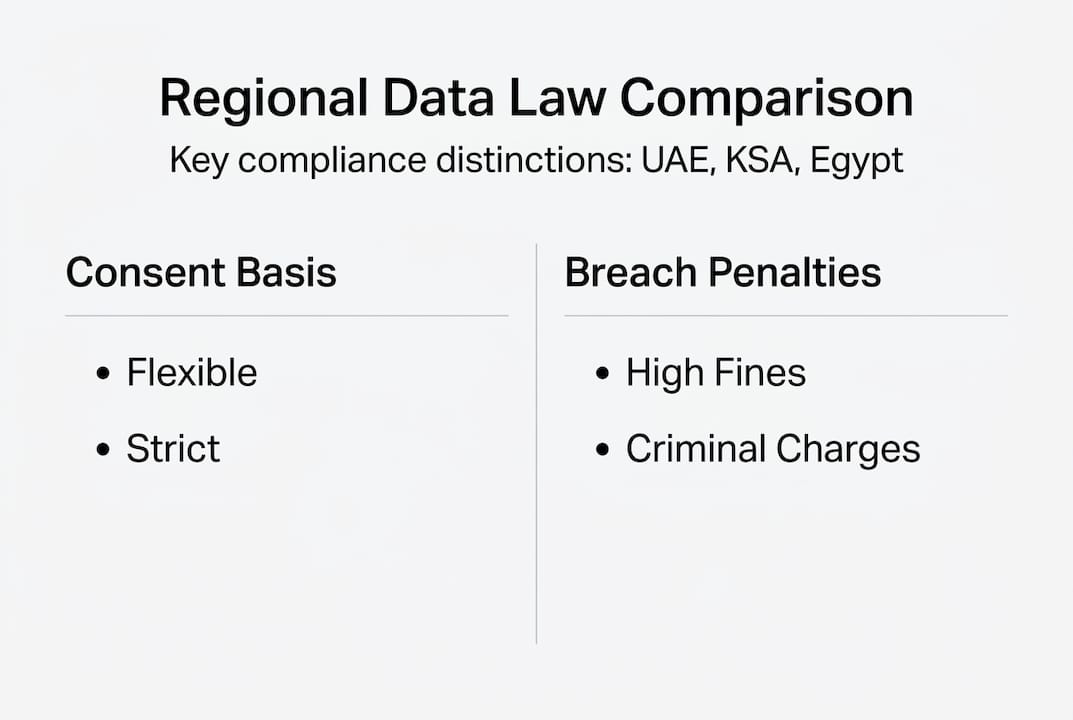
| Consent basis | Flexible, including legitimate interest | Consent-first, few exceptions | Explicit consent required |
| DPO requirement | Recommended | Mandatory in many cases | Mandatory |
| Data transfers | Adequate countries or safeguards | Regulated with safeguards | Prior license required (up to 90 days) |
| Penalties | Administrative fines | Criminal, up to SAR 5M and imprisonment | Criminal, up to EGP 5M and imprisonment |
| Enforcement status | Active | Active | Full enforcement by October 31, 2026 |
UAE’s PDPL offers GDPR-like flexibility with legitimate interest as a processing basis. KSA’s PDPL is consent-first with very limited exceptions, reflecting a strong data sovereignty posture. Egypt’s Data Protection Law demands explicit consent for sensitive data and marketing, and its 72-hour breach notification rule is among the strictest in the region.
Sector overlays add another layer entirely. Banking and financial services require dual compliance in both KSA and Egypt, where SAMA’s frameworks and CBE exemptions operate alongside the general data laws. Healthcare organizations face a similar layered reality. Assuming the national data law covers everything is a common and costly mistake.
Key compliance contrasts to keep in mind:
- Egypt’s enforcement grace period ends October 31, 2026, so organizations still in preparation mode are running out of time
- KSA and Egypt both carry criminal liability for senior officers, not just corporate fines
- Regional disruption examples show that enforcement actions in one country often trigger regulatory scrutiny in others
Building a compliance matrix that maps each jurisdiction’s requirements against your specific sector is not optional. It is the minimum viable starting point.
Operationalizing compliance: Governance, risk, and RegTech automation
With the legal landscape mapped, the next challenge is embedding compliance into every layer of digital projects. Knowing the rules is one thing. Building systems that enforce them automatically is another.

The RegTech market in the Middle East reached $1.66 million in 2024 and is growing at a CAGR of 18.5% through 2029. More importantly, RegTech platforms reduce compliance workloads by up to two-thirds and cut onboarding and acquisition costs significantly. These are not marginal gains. They are structural advantages for organizations that adopt early.
Here is how to operationalize compliance effectively:
- Implement the three lines of defense. Business units own first-line compliance. The risk and compliance function provides second-line oversight. Internal audit delivers independent third-line assurance. This structure, outlined in KPMG’s compliance transformation framework, prevents compliance from becoming siloed in one department.
- Embed compliance in your SDLC. Every software development lifecycle stage, from requirements through deployment, should include compliance checkpoints, data flow diagrams, and audit logging.
- Automate monitoring and reporting. RegTech tools can flag policy deviations in real time, generate audit-ready reports, and maintain evidence trails without manual effort.
- Assign clear ownership. Each compliance control should have a named owner at the business unit level, not just a policy document.
- Run regular tabletop exercises. Simulate a breach or regulatory inquiry annually to stress-test your response capabilities.
Pro Tip: Do not wait for a regulator to ask for your audit trail. Build logging and documentation into every digital workflow from the start. Retroactive compliance documentation is expensive and often incomplete.
For organizations looking to move from reactive to proactive, proven process compliance strategies offer a practical framework for integrating governance into daily operations.
Navigating sector overlays and emerging risks: AI, cross-border, localization
Beyond the basics, several high-risk edge cases and sector requirements can trip up even well-prepared organizations. These are the areas where compliance failures tend to be most severe and least anticipated.
AI and automation ethics are now a formal compliance category in KSA. SDAIA’s ethics and risk alignment requirements mean that AI systems used in consequential decisions, such as credit scoring, patient triage, or government service delivery, must include human-in-the-loop controls and documented risk assessments. Deploying AI without these safeguards is not just a reputational risk. It is a regulatory one.
Cross-border data transfers require careful pre-planning:
- UAE permits transfers to adequate countries or with appropriate safeguards
- KSA regulates transfers and requires contractual safeguards
- Egypt requires a prior license that can take up to 90 days to obtain, making last-minute transfers impossible
KSA’s data localization rules are among the strictest in the region. The NCA’s Essential Cybersecurity Controls and Cloud Cybersecurity Controls mandate local storage for personal and sensitive data. Cloud-first architectures that rely on international data centers may require significant redesign to meet these requirements.
Sector overlays in banking (SAMA in KSA, CBE in Egypt) and healthcare add requirements that sit above the general data laws. Non-compliance with these overlays can trigger regulatory shutdowns, not just fines.
Pro Tip: If your digital project involves AI-driven decisions or cross-border data flows, map your compliance requirements before selecting your technology stack. Retrofitting localization or human oversight controls after deployment is far more costly than designing for them upfront.
Leaders managing AI security and compliance and securing AI-driven data will find that governance frameworks built for traditional IT rarely cover the full surface area of AI risk.
Cost of non-compliance: Penalties, breach impact, and the case for strategic governance
Given these real-world regulatory hazards, the consequences of missed compliance are striking. The numbers make a compelling case for investment in governance.
The average data breach cost in the Middle East reached SAR 27 million in 2025, down 18% from SAR 32.8 million the previous year. Finance sector breaches average SAR 34 million, and energy sector breaches average SAR 32 million. Lost business remains the single largest cost component at SAR 11.63 million per incident.
On the regulatory side, penalties differ sharply by country:
- UAE imposes administrative fines, with no criminal liability for executives
- KSA treats violations as criminal offenses, with fines up to SAR 5 million and imprisonment up to two years
- Egypt also applies criminal penalties, with fines up to EGP 5 million and potential imprisonment
Personal liability at the C-level is real in KSA and Egypt. This is not a compliance team problem. It is a board-level risk that executives must own directly.
“The organizations that treat compliance as a governance investment, not a cost center, consistently outperform their peers in audit readiness, breach recovery speed, and regulatory trust.” — Tamer Badr, Singleclic
Technology helps. AI, encryption, and DevSecOps practices all reduce breach costs and detection times. But technology without governance is just automation of risk. The strongest programs pair RegTech tools with a culture of accountability that starts at the top. Digital government success stories from the region consistently show that governance-first organizations recover faster and face fewer repeat violations.
Perspective: Compliance as your strategic enabler, not just a box to tick
Most organizations in the region still treat compliance as a disruption. A project gets delayed for a legal review. A product launch stalls waiting for a DPO sign-off. The instinct is to minimize compliance involvement and move fast. This approach consistently backfires.
The organizations we work with that have embedded compliance into their digital culture tell a different story. They move faster through audits. They win regulated-sector contracts more easily. They recover from incidents without the reputational damage that derails others. Compliance, done right, becomes a source of digital trust.
The shift from checkbox to governance culture is already underway across MEA. RegTech platforms are transforming compliance from a manual, reactive function into a real-time, strategic capability. The C-level executives who recognize this shift early are the ones positioning their organizations for sustainable growth in regulated markets.
Your role is not to delegate compliance down the chain and hope for the best. It is to model the mindset, fund the governance infrastructure, and hold the organization accountable. Staying ahead of emerging C-level trends means recognizing that regulatory leadership is now a competitive differentiator, not just a legal obligation.
Take your digital compliance to the next level
Digital compliance is no longer a back-office function. It is a board-level priority that shapes which markets you can enter, which contracts you can win, and how quickly you recover when things go wrong.
At Singleclic, we help C-level leaders and compliance officers across KSA, UAE, and Egypt build compliance into the foundation of their digital projects, not bolt it on afterward. Our Digital Transformation Office delivers end-to-end compliance strategy alongside technology implementation. Explore how automation for C-level leaders can reduce your compliance workload while strengthening governance. For AI-specific risk, our AI security and compliance services give you the frameworks and tools to deploy AI responsibly across all three jurisdictions.
Frequently asked questions
Do I need separate compliance programs for UAE, KSA, and Egypt?
Yes. Each country has distinct data laws, enforcement timelines, and sector overlays, so compliance must be tailored and jurisdiction-mapped independently. A single policy will leave critical gaps in at least one country.
What are the risks if my digital project does not comply?
Penalties include criminal charges, fines up to SAR 5 million in KSA and EGP 5 million in Egypt, and significant business disruption from regulatory action or breach response costs.
How can RegTech help with compliance in digital projects?
RegTech reduces compliance workloads by up to two-thirds and automates monitoring, audit reporting, and documentation, freeing executive attention for strategy rather than manual oversight.
What is special about cross-border data transfer rules in Egypt?
Egypt requires a prior license for data transfers that can take up to 90 days to obtain, combined with a 72-hour breach notification requirement that demands a fully operational incident response capability.
How soon will Egypt’s PDPL be fully enforced?
Egypt’s grace period ends October 31, 2026, after which full enforcement applies. Organizations still in preparation mode should treat this deadline as urgent and non-negotiable.