Most digital transformation initiatives don’t fail because of bad technology. They fail because the requirements driving that technology were never properly understood. 70 to 89% of transformations fall short of their goals, and inadequate requirements analysis sits at the center of that problem. If you’re a business analyst or decision-maker in KSA, UAE, or Egypt, this guide gives you a structured, practical approach to getting requirements right before a single line of code is written or a single system is configured. Every section builds on the last, moving you from concept to execution to validation.
Table of Contents
- Understanding business requirements analysis
- Preparation: Gathering and clarifying requirements
- Execution: Analyzing, prioritizing, and documenting requirements
- Verification and stakeholder validation
- Navigating MENA-specific challenges in requirements analysis
- Our perspective: What most guides miss in requirements analysis
- Accelerate your digital transformation with expert support
- Frequently asked questions
Key Takeaways
| Point | Details |
|---|---|
| Preparation pays off | Investing in upfront requirements analysis is ten times cheaper than fixing issues later. |
| Use multi-technique elicitation | Combining interviews, workshops, and observation uncovers hidden needs and reduces risk. |
| Prioritize and validate | Using frameworks like MoSCoW and regular stakeholder validation prevents costly scope creep. |
| Adapt for MENA context | Accounting for local regulatory and cultural factors ensures your analysis leads to successful digital transformation in KSA, UAE, and Egypt. |
Understanding business requirements analysis
Business requirements analysis is the process of identifying, documenting, and validating what an organization needs to achieve through a digital initiative. It’s not about listing features. It’s about understanding the business problem deeply enough that any solution you build actually solves it.
Think of it as the roadmap for business growth that sits beneath every technology decision. Without it, teams build systems that technically work but operationally fail.
“A requirement is only as good as the understanding behind it. If your analysts don’t grasp the business context, they’ll document symptoms instead of causes.” — Tamer Badr, Singleclic
Business requirements analysis follows a structured process that moves through several core stages: understanding the current state (as-is analysis), defining the desired future state, identifying gaps, and specifying both functional and non-functional requirements. Each stage feeds the next.
Here’s what strong requirements analysis covers:
- Functional requirements: What the system must do, including specific behaviors, workflows, and outputs
- Non-functional requirements: How the system must perform, including speed, security, scalability, and compliance
- Stakeholder involvement: Who needs to be consulted, who has decision authority, and who will be impacted
- As-is documentation: A clear picture of current processes, pain points, and data flows
- Gap assessment: The delta between where you are and where you need to be
The business case for rigor here is strong. Projects with formal requirements are 62% more likely to succeed than those that treat requirements as an afterthought. That single statistic should reframe how much time and budget you allocate to this phase.
Weak requirements create a cascade of problems: rework, scope creep, missed deadlines, and systems that users reject. Strong requirements create alignment, predictability, and a foundation that every downstream team can build on confidently.
Preparation: Gathering and clarifying requirements
To build a strong foundation, start your analysis with meticulous preparation. Skimping here is one of the most expensive mistakes a project team can make. Problems caught during requirements gathering cost a fraction of what they cost to fix after deployment.
Hybrid approaches blend predictive strategy with adaptive iteration, and the most effective teams spend 40 to 50% of their total project effort on gathering and clarifying requirements. That’s not excessive. That’s protective.
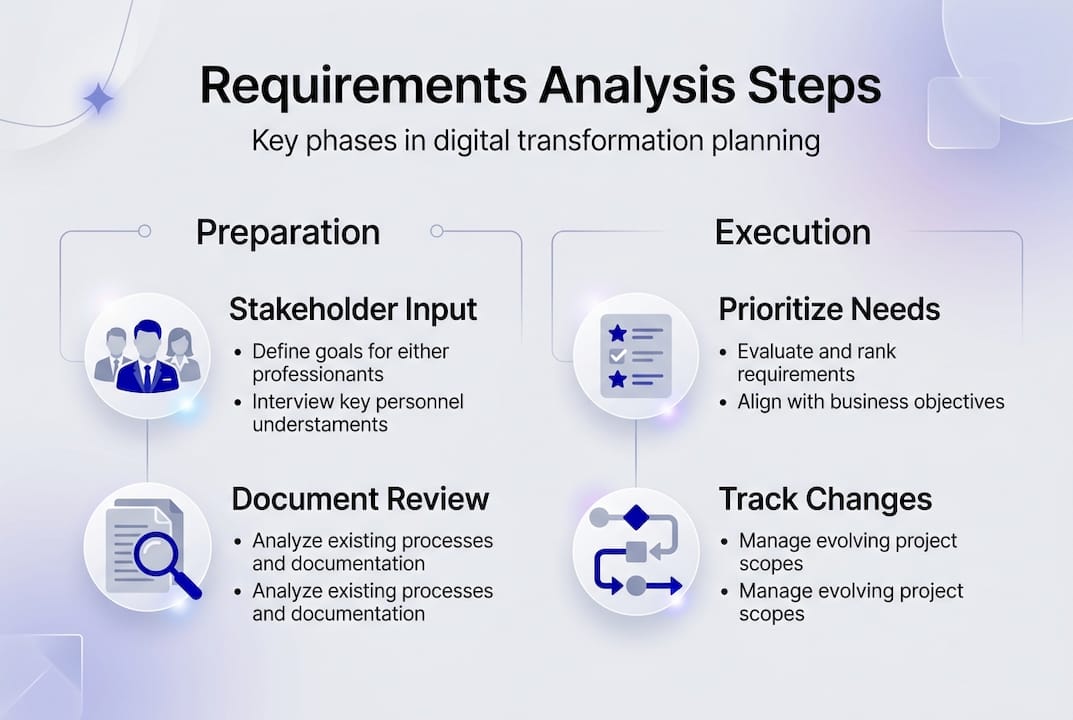
You need multiple elicitation techniques. No single method surfaces everything you need to know. Prioritize multi-technique elicitation to uncover hidden needs that stakeholders don’t even know they have.
The most effective methods include:
- Structured interviews: One-on-one sessions with process owners and end users to capture firsthand knowledge
- Facilitated workshops: Group sessions that surface conflicting priorities and build shared understanding
- Observation: Watching how people actually work, not just how they say they work
- Documentation review: Analyzing existing process maps, system specs, and compliance records
- Surveys: Useful for large stakeholder groups where individual interviews aren’t feasible
| Technique | Best used for | MENA consideration |
|---|---|---|
| Structured interviews | Senior stakeholders | Respect hierarchy and seniority norms |
| Workshops | Cross-functional alignment | Arabic language facilitation may be needed |
| Observation | Operational processes | On-site visits are often essential |
| Documentation review | Regulatory compliance | Local laws vary by country |
Pro Tip: In KSA and UAE especially, senior stakeholders often prefer one-on-one interviews over group workshops. Respecting this preference gets you better information and stronger buy-in.
Before you start gathering, use a transformation checklist to confirm your team has the right roles in place: a business analyst, a subject matter expert, a project sponsor, and at least one technical architect. You also need a clear operational excellence roadmap so that requirements connect to strategic outcomes, not just tactical fixes.
Execution: Analyzing, prioritizing, and documenting requirements
With your groundwork set, it’s time to dive into the heart of requirements analysis. This is where raw information becomes structured, actionable documentation that your delivery team can actually use.
The workflow follows a logical sequence:
- Consolidate inputs: Organize everything gathered during elicitation into a single, structured repository
- Conduct as-is analysis: Map current processes in detail, identifying inefficiencies, bottlenecks, and compliance gaps
- Define the to-be state: Describe the desired future state in business terms, not technical ones
- Identify gaps: Document what needs to change, what needs to be built, and what can be retired
- Classify requirements: Separate functional from non-functional, and mandatory from optional
- Prioritize: Apply a structured method to rank requirements by business value and urgency
MoSCoW prioritization is one of the most practical tools available. It categorizes every requirement as Must-have, Should-have, Could-have, or Won’t-have. This prevents the common failure mode where teams try to deliver everything and end up delivering nothing well. Non-functional requirements, such as system uptime, data residency, and Arabic language support, are frequently neglected and become critical failure points later.
Pro Tip: Document non-functional requirements with the same rigor as functional ones. A system that works but runs too slowly or fails a compliance audit is still a failed system.
| Approach | Strengths | Weaknesses |
|---|---|---|
| Traditional (waterfall) | Predictable, documented | Inflexible, slow to adapt |
| Agile | Adaptive, iterative | Can lack documentation rigor |
| Hybrid | Balanced structure and flexibility | Requires skilled facilitation |
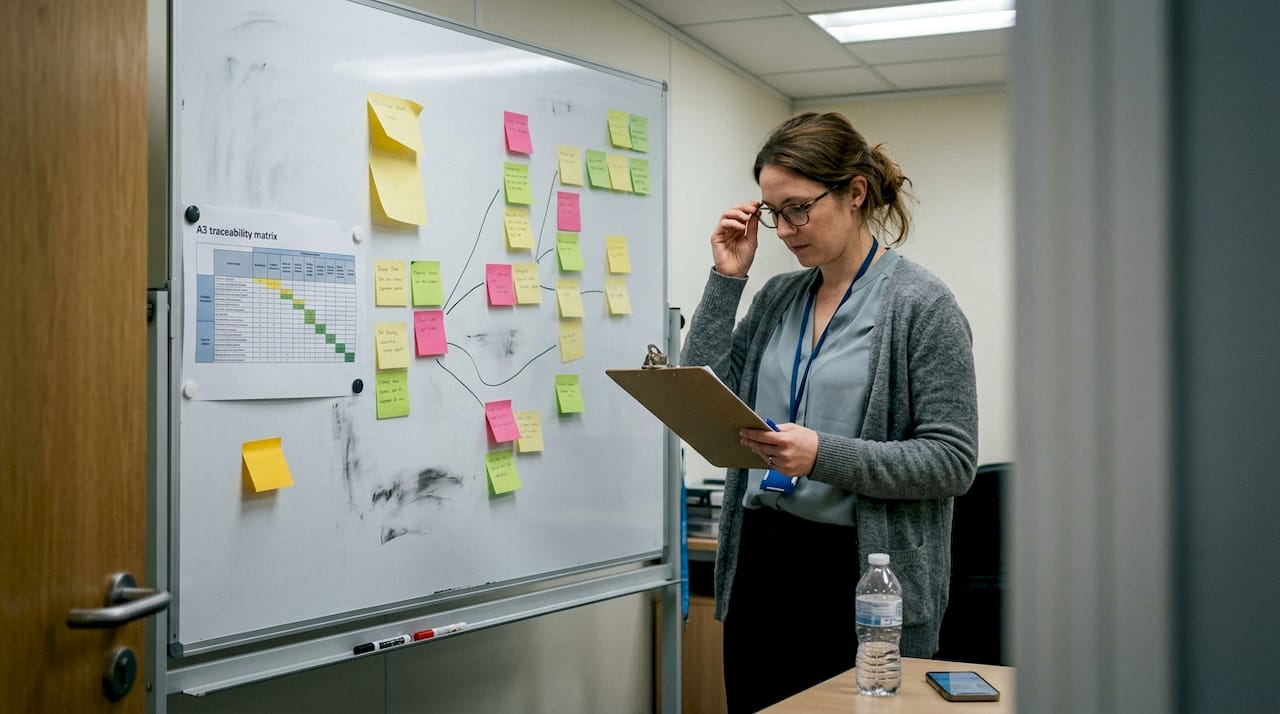
Traceability and requirement management are what connect every documented requirement to a business objective, a test case, and a delivered feature. A solid requirements management workflow ensures nothing gets lost between analysis and delivery, and that every change is tracked and approved.
Verification and stakeholder validation
Thorough analysis means nothing if your requirements aren’t verified and validated. These two activities are related but distinct, and skipping either one creates serious risk.
Verification checks internal consistency. Are requirements complete, unambiguous, and free of contradictions? This is an internal quality check your team performs before presenting anything to stakeholders.
Validation checks that requirements actually reflect stakeholder needs. Always verify internal consistency before you validate stakeholder needs, because presenting inconsistent requirements to stakeholders wastes their time and erodes trust.
Common pitfalls to watch for:
- Requirements that are technically correct but don’t reflect real user workflows
- Missing sign-off from key stakeholders, leaving room for later disputes
- No traceability matrix, making it impossible to track changes
- Validation sessions that are too rushed or involve the wrong people
- Assuming silence equals approval during review cycles
“The cost of fixing a requirement error after deployment is ten times what it costs to catch it before development begins.” — Tamer Badr, Singleclic
Upfront investment is 10x cheaper than post-deployment fixes. That ratio makes a compelling case for structured validation cycles, not informal email reviews.
Traceability avoids scope creep by giving every requirement a unique identifier that follows it through design, development, testing, and deployment. When a stakeholder requests a change, you can immediately see its impact on the entire project. This is especially important in complex MENA transformation programs where transformation failure statistics show that scope creep is a leading cause of budget overruns. An innovation workflow that includes formal change control keeps your project on track without stifling necessary evolution.
Navigating MENA-specific challenges in requirements analysis
Finally, tailor your analysis process to the realities of doing business in KSA, UAE, or Egypt. The standard frameworks are a starting point, not a complete answer. Cultural and regulatory nuances are critical in MENA and can make or break a requirements process that works perfectly elsewhere.
Here’s what you must account for:
- Regulatory compliance: Saudi Vision 2030, UAE data protection laws, and Egypt’s digital government mandates all impose specific documentation and data residency requirements that must be captured as non-functional requirements from day one
- Language: Requirements documents and validation sessions may need to be conducted in Arabic, and systems must often support bilingual interfaces
- Stakeholder hierarchy: Decision-making authority is often concentrated at senior levels; getting the right approvals requires navigating organizational structure carefully
- Digital maturity variance: Readiness varies significantly between government entities, banks, and private sector organizations, and your requirements process must adapt accordingly
- Change management culture: Resistance to process change is common; requirements sessions that involve end users early reduce adoption risk later
Pro Tip: Always include a compliance review step specific to the country of deployment. A requirement that’s standard in one market may conflict with local law in another.
The rise of low-code in MENA has also changed what’s possible. Platforms like Cortex, Singleclic’s Arabic-enabled on-premise low-code platform, allow organizations to prototype and validate requirements visually, which dramatically improves stakeholder engagement and reduces misunderstandings before development begins.
Our perspective: What most guides miss in requirements analysis
Most requirements analysis guides give you a checklist and call it a day. The uncomfortable truth is that checklists don’t capture context, and context is everything.
In our experience leading transformation across KSA, UAE, and Egypt, the most expensive failures we’ve seen weren’t caused by wrong tools or missing templates. They were caused by teams that spent weeks selecting software before they understood their own processes. They were caused by analysts who documented what stakeholders said they wanted, not what they actually needed.
Here’s the contrarian insight: spend more time on stakeholder alignment than on tool selection. The right platform chosen with poor alignment will fail. A simpler platform chosen with strong alignment will succeed. Alignment takes longer, requires more facilitation skill, and produces fewer deliverables in the short term. But it’s the single highest-return investment in any transformation program.
The other thing most guides miss is change management. Requirements analysis is not just a technical exercise. It’s a change management exercise. Every session you run is an opportunity to build ownership and reduce resistance. Treat it that way.
Accelerate your digital transformation with expert support
If you’re ready to put these principles to work, here’s your next step. Getting requirements right is the foundation, but executing a full digital transformation across KSA, UAE, or Egypt requires more than a good framework.
At Singleclic, our digital transformation office supports organizations from requirements analysis through full delivery, with 70+ consultants who understand the regional context deeply. Whether you need a structured C-level roadmap or hands-on implementation support, we bring both the methodology and the regional expertise to make your initiative succeed. Explore what’s possible at Singleclic and take your transformation from concept to reality.
Frequently asked questions
What is the difference between business and functional requirements?
Business requirements define what the organization needs to achieve at a strategic level, while functional requirements specify how the system will fulfill those needs through specific behaviors and features.
Why do so many digital transformation projects fail?
Most failures stem from poor requirements gathering, misalignment with business strategy, and inadequate change management. 70 to 89% of transformations fall short, often because requirements were never properly validated.
How does MoSCoW prioritization help in requirements analysis?
MoSCoW prioritization ranks requirements as Must-have, Should-have, Could-have, or Won’t-have, helping teams allocate resources to what matters most and align stakeholder expectations before development begins.
What are the signs of effective requirements documentation?
Effective documentation is clear, traceable, and validated by stakeholders. Maintaining traceability throughout the project lifecycle prevents scope creep and ensures every requirement connects to a measurable business outcome.
How can regulatory and cultural differences in KSA, UAE, and Egypt impact requirements analysis?
Local laws, language preferences, and organizational hierarchies directly shape how requirements are gathered and documented. Cultural and regulatory nuances in MENA require analysts to adapt their methods rather than apply generic frameworks without adjustment.
Recommended
- Singleclic: Download the 7-step digital transformation checklist for leaders to drive growth, align stakeholders, and optimize operations—start today.
- 7 Key Benefits of Digital Transformation for Business Leaders
- Digital Transformation Roadmap for Business Growth Success
- Digital Transformation Roadmap for C-Level Success